Before you sell / overhanging trees and neighbour complaints
The grove or garden trees overhang the neighbours and a complaint has come. What to do first, the new rule letting neighbours cut, and letting the house go trees and all
A complaint about the trees at the family home usually reaches you first as a phone call from the neighbour. What to do first, what the April 2023 Civil Code amendment changed, costs and support, and letting go, trees and all.
When a complaint comes: reply the same day, record with photos, give your contact details
Since April 2023 the neighbour may cut if you ignore a demand, cannot be identified, or it is urgent
No need to pay for felling first. We can buy as-is with the trees still overgrown
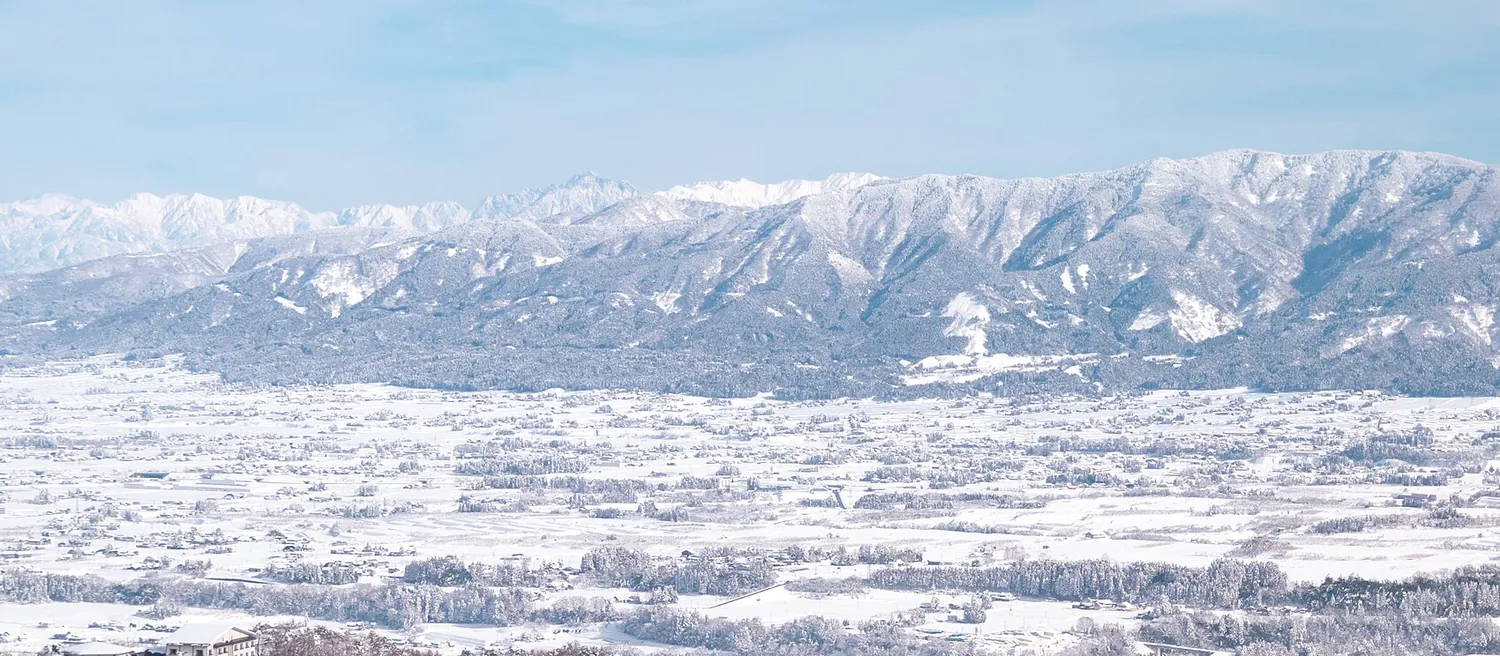
The Tonami plain and its scattered villages under snow
Real estate + constructionA builder with both a real estate licence and a construction permit
Appraisal and survey: ¥0No charge if you decline
Toyama, Ishikawa and HidaOwners living elsewhere welcome
When a complaint comes: four things you can do from another prefecture
The order is reply, record, contact details, date. The first three can be done from another prefecture by phone and post. Only the fourth, when the contractor comes in, needs someone on site.
The person who contacted you does not want to blame you; they are having trouble. Reply, keep a record, hand over your contact details. All of that can be done the same day, from another prefecture.
Word from a neighbour or the neighbourhood association comes before any notice from the authorities. Act now and most of it stays within neighbourly relations. Let the seasons pass without replying, and another autumn of leaves and winter of snow come round, and the matter goes to the city office. The order is these four.
1. Reply the same day"Thank you for letting me know. We will have the branches cut by the end of the year." Phone or letter, either is fine. The contractor and cost need not be settled yet; just make clear first that you do not intend to leave it. Silence is what sours things most.
2. Record it in photosWhich branches of which tree cross how far into the neighbour's land, and where the leaves collect. If you cannot go back, ask the person who contacted you whether they could send photos. With a few dated photos, you can even ask a contractor for a quote by phone.
3. Give the neighbour and the association head your contact detailsYour phone number and address, on paper rather than by word of mouth. This is so that the next time a branch breaks, the call comes to you before it goes to the city office. As we wrote in A year-round calendar for managing a vacant house from afar, this is the single most effective move in managing from a distance.
4. Say what you will do by whenAsk a landscaper or the Silver Human Resources Centre for a quote and say "the branches will be cut by such-and-such month". The natural targets are autumn before the leaves fall and November before the snow. Even one of the two: the moment you name a date, the other side feels differently.
When arranging it from another prefecture, tell the neighbour in advance which day the contractor is coming. An unknown vehicle pulling up next door and "the trees are being cut on the such-and-such" are received quite differently. Who to hire is covered in the cost section below.
Since the April 2023 Civil Code amendment, the neighbour can cut the branches themselves
A neighbour may cut only in three cases: asked but not cut, owner unknown, or urgent need. An owner who replies does not fall under the first two.
Some of you will have heard that "the neighbour can now cut them without asking" and felt uneasy. It is true: this is the amended Civil Code Article 233, in force from 1 April 2023. But read the content, and for an owner who replies it is if anything reassuring.
Before the amendment, even with a neighbour's branches overhanging, all the affected side could do was "have the owner cut them". If the owner was in another prefecture and unreachable, or asked and did nothing, the neighbour was helpless. That principle still stands after the amendment. On top of it, when any of the following three applies, the affected side may now cut the branches themselves.
When the owner has been asked to cut the branches and does not do so within a reasonable period. What is "reasonable" depends on the case, but the Ministry of Justice's commentary puts it at about two weeks as a rule
When the tree's owner cannot be identified or located. A house still registered in a deceased parent's name with no contact details for the heirs anywhere falls under this
When there is urgent need. A broken branch about to fall on the neighbour's roof, or a typhoon about to bring it onto power lines, for example
Two further rules go with it. Roots may be cut without any prior request (paragraph 4; this was the position before the amendment too). If bamboo or sasa rhizomes have spread next door, the neighbour can cut the roots at any time. And even where the trees are co-owned by siblings, one co-owner alone may cut the branches (paragraph 2). If you have been stuck on "we can't cut without every sibling's consent", this one sentence frees you to act.
In other words, if you do as the first section of this page says — reply, give your contact details, and state a deadline — you fall into neither the first nor the second case. Put the other way round, once two weeks pass without a reply, the neighbour becomes legally entitled to cut it themselves. That's not something to be afraid of; it's a reason to act before it gets there. If the neighbour cuts the branch off themselves, they can reportedly bill the tree's owner for the cost, according to the Ministry of Justice. Check the wording in Civil Code art. 233 on e-Gov Japanese Law Search, and the purpose of the revision in the Ministry of Justice's explanation.
Why a windbreak grove gets out of hand within a few years
In the scattered villages of the Tonami plain, houses ringed by groves stand dotted among the rice fields. As we wrote on the Tonami page, these groves, called kainyo, were there to shield the house from the strong winter winds sweeping across the Shogawa alluvial fan. Cedars grown tall on the west and south sides, mixed with zelkova, persimmon and bamboo. Leaves for compost, branches for fuel, thick trunks for timber when the house was rebuilt. A rational system from an age when life and trees were one. The same landscape is found on the Kurobe River fan in Nyuzen, the east side of Oyabe, and Fushiki and Fukuoka in Takaoka.
That system broke down when nobody lived in the house any more. While someone is there, the leaves are raked in autumn, snow fencing goes up before winter, and the trees are pruned every few years. Once this stops, a grove becomes "out of hand" within a few years. There are three reasons.
The trees are too tall for an amateur to climbThe cedars and zelkovas of a grove grow far higher than the main house's roof. Unlike pruning garden trees, it takes a cherry picker or a craftsman who can climb. It is not a height you can deal with yourself on one trip home a year.
Leaves and snow damage the gutters and roofCedar needles collect in the gutters, the blocked gutters overflow and the eaves rot. In winter wet snow loads the branches, and broken branches fall onto the roof and the neighbour's land. As written in the year-round calendar, June to September is grass and garden trees, October to November gutter cleaning and snow fencing, December to February roof snow. For a house with trees, every part of that year is a step heavier.
Over power lines or the road, you cannot cut them yourselfIf branches are close to touching power lines, do not cut them casually, whether yourself or through a landscaper; contact the power company first. There is a risk of electrocution and power cuts. Branches overhanging the road are the part most likely to be reported to the city as an obstruction.
Among the Tonami enquiries we receive, a common phrase is "I need to deal with the trees before the house". A house that merely stands there bothers no neighbour, but trees grow every year, shed every year and snap every year. What draws complaints is usually the trees, not the house.
The cost of felling and pruning, and the burden that continues every year
Felling is not a one-off payment that ends the matter; as long as the house remains, upkeep continues. Let it go as it stands, trees and all, and you pay no felling cost up front, and the trees that can stay, stay.
We cannot write one figure here for "what does it cost". Felling and stump removal in a grove, as set out in Demolition costs, vary widely with the number and size of trees. A landscaper quotes per tree, and the height, trunk girth, whether machinery can get onto the lot, distance from power lines and the neighbour's house, and how the cut trunks and branches are carried out can multiply the figure several times for the same number of trees. Disposal and stump removal (digging out the stumps) are normally quoted separately from felling.
We use only two guide figures. For ordinary garden trees, as written on the What to do with the family home page, mowing and garden-tree care come to ¥30,000–100,000 a year; pruning the tall trees of a grove does not fit within that. And demolition to a cleared lot including the kura, barn and grove often passes ¥3 million in total. Somewhere between those two lies the figure for your trees.
What is easily overlooked is that felling is not a one-off payment that ends the matter. Cut the trees and the house remains, with property tax, insurance and mowing going on. Upkeep of a vacant house is about ¥150,000–400,000 a year, and tree maintenance is only part of it. Conversely, if you keep the trees and maintain them every year, that cost runs until you let the house go. Either way, unless you first decide what will ultimately happen to this house, the money spent on the trees is left hanging.
There are three places to ask.
A landscaper. Can be asked for the whole job, from pruning tall trees to felling and stump removal. In Tonami, Nanto and Oyabe there are firms whose main work is pruning and felling grove trees. Get two quotes, and always check whether disposal and stump removal are included and whether they can handle a request from another prefecture by photo and phone
The Silver Human Resources Centre. They can be asked for mowing and low garden trees, but usually cannot take trees higher than the roof or work that needs a ladder. Check what each centre will accept
The forestry cooperative. In some areas the forestry cooperative takes on grove pruning. Check with the cooperative or the city office whether yours does
We are not landscapers, so we do not take on felling itself. What we can do is tell you, free, what the house is worth with the trees on it before you cut anything. Paying for felling and then selling, or selling as it stands trees and all, leave different amounts in your hands. The order of calculation is: put the felling quote and the appraisal side by side first.
If you keep the grove: support from Tonami, Nanto and the prefecture
For those who want to keep and maintain the trees rather than cut them, there is city and prefectural support. The scattered villages of the Tonami plain are a landscape chosen by the Ministry of the Environment as an "important satoyama", and the authorities do not want to lose groves either. We give only the scheme names and official pages. Amounts and conditions change each fiscal year, so always check the official source.
Tonami City: scattered-village landscape conservation scheme (support for pruning and growing groves)For districts that have signed a "community-building agreement making use of the scattered-village landscape" and work as a community to keep their groves and landscape. The city and prefecture pay part of the cost of landscape-sensitive, specialist work such as pruning and thinning tall trees. Check with the city whether yours is an agreement district. → Tonami City guidance
Nanto City: grove conservation supportThis too is for parties to a "community-building agreement making use of the scattered-village landscape", and supports work needing specialist skills such as pruning grove trees. Nanto City also runs a special collection for pruned and broken branches from groves. → Nanto City guidanceSpecial collection of pruned and broken branches
Toyama Prefecture: scattered-village landscape conservation schemeTo lighten the financial and physical burden on grove owners and pass the scattered-village landscape to the next generation, the prefecture supports residents' agreements. The city schemes sit on top of this prefectural framework. → Toyama Prefecture guidance
Two conditions are common to all of them. One is being in an agreement district: these are not schemes an individual applies to alone, but require the district to have signed an agreement. The other is that what is supported is pruning to grow the grove. They exist to keep groves healthy, so felling itself, or stripping a tree bare, falls outside their purpose. Check with the city on what exactly is covered. Understand them as schemes for those who have decided to keep the grove. Whether a vacant house can join the agreement depends on the district, and the quickest way to find out is through the neighbourhood association head.
Deciding which trees to keep and which to cut. Before you cut them all
When a complaint comes, it is tempting to think "just cut the lot". But a house with its whole grove felled takes the winter wind head on, and is no longer a scattered-village house in either its scenery or its price. The order we use on site is dangerous trees first, and keep the trees that do a job.
Deal with first: trees close to the house or the neighbour, leaning trees, dead treesTrees whose branches reach the main house's roof or the neighbour's roof, trees whose trunks lean towards the neighbour, trees that no longer leaf. These three are the cause of complaints and do the most damage if they fall. Fell them, or prune them hard, first.
Keep: the windbreak rows on the west and south, and thick healthy treesA grove's job is to break the wind. The rows of cedars standing together on the west and south sides protect the house, so they stay. Trees with thick, straight trunks and good leaf colour need only lifting (removing the lower branches and keeping the crown) to cut the leaf fall and shade considerably.
Can be cut: trees crowded inside the lot, self-seeded treesThe crowded saplings that sprang from seed in the years without maintenance rob the trees you keep of nutrients. Thinning them makes the remaining trees stronger in the wind.
Tonami City publishes a guide, "Growing a wind-resistant, easy-to-manage grove". It explains at what height to prune and which trees to thin, so reading it once before talking to a landscaper makes the conversation quicker.
One more thing to know. To a buyer making a guesthouse or a shop, the grove is value. A house standing alone among rice fields, ringed by tall cedars, is a view you cannot buy in a city. When we are asked to turn a kominka into a whole-house guesthouse, a house that still has its grove goes near the top of the list for that alone. Seen only as the burden of leaves and snow, cutting is the one answer. Seen through the next user's eyes, reasons to keep it appear.
Letting the house go trees and all. There is no need to fell before selling
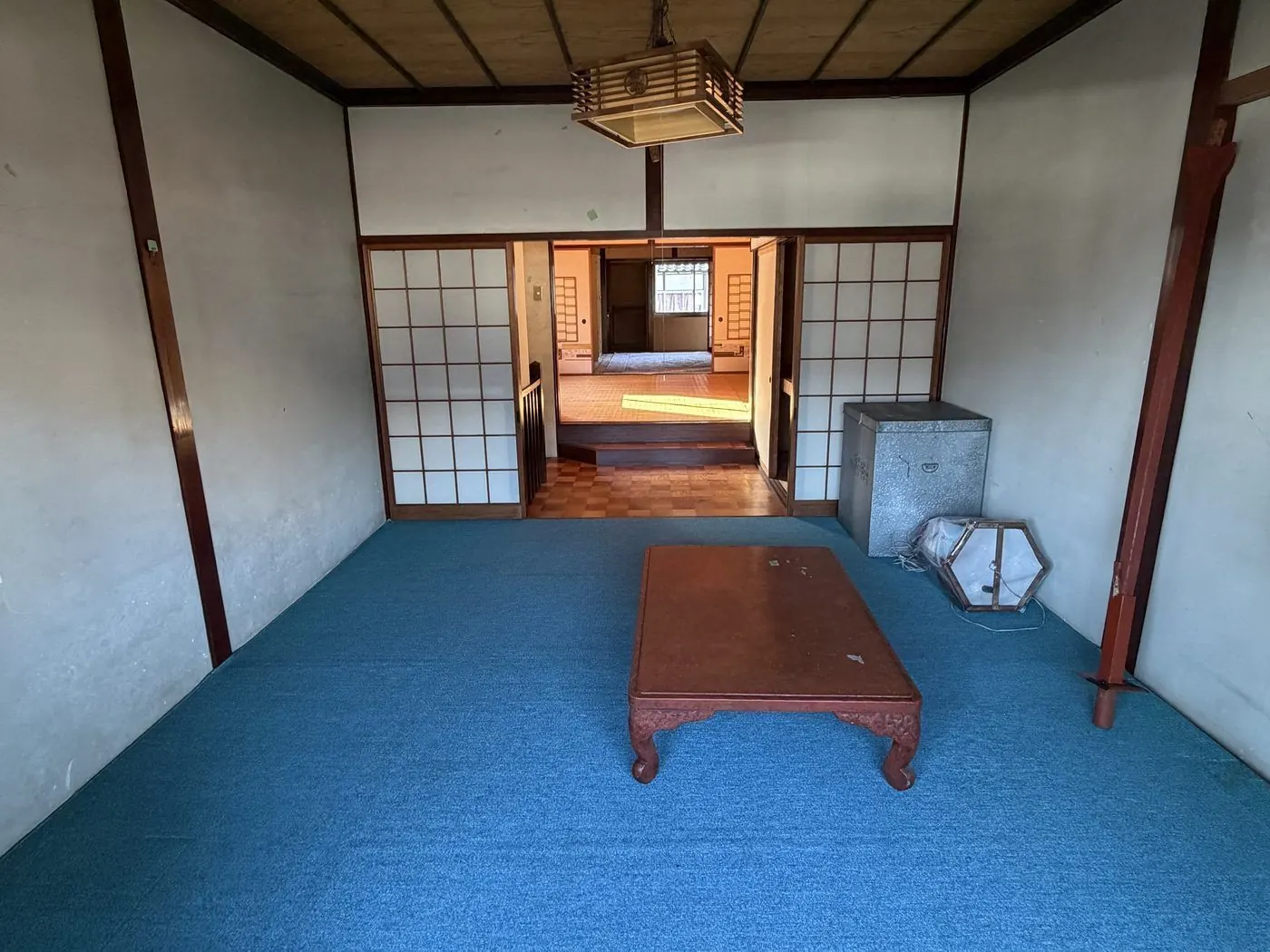
Tatami room before renovation (our project)
→
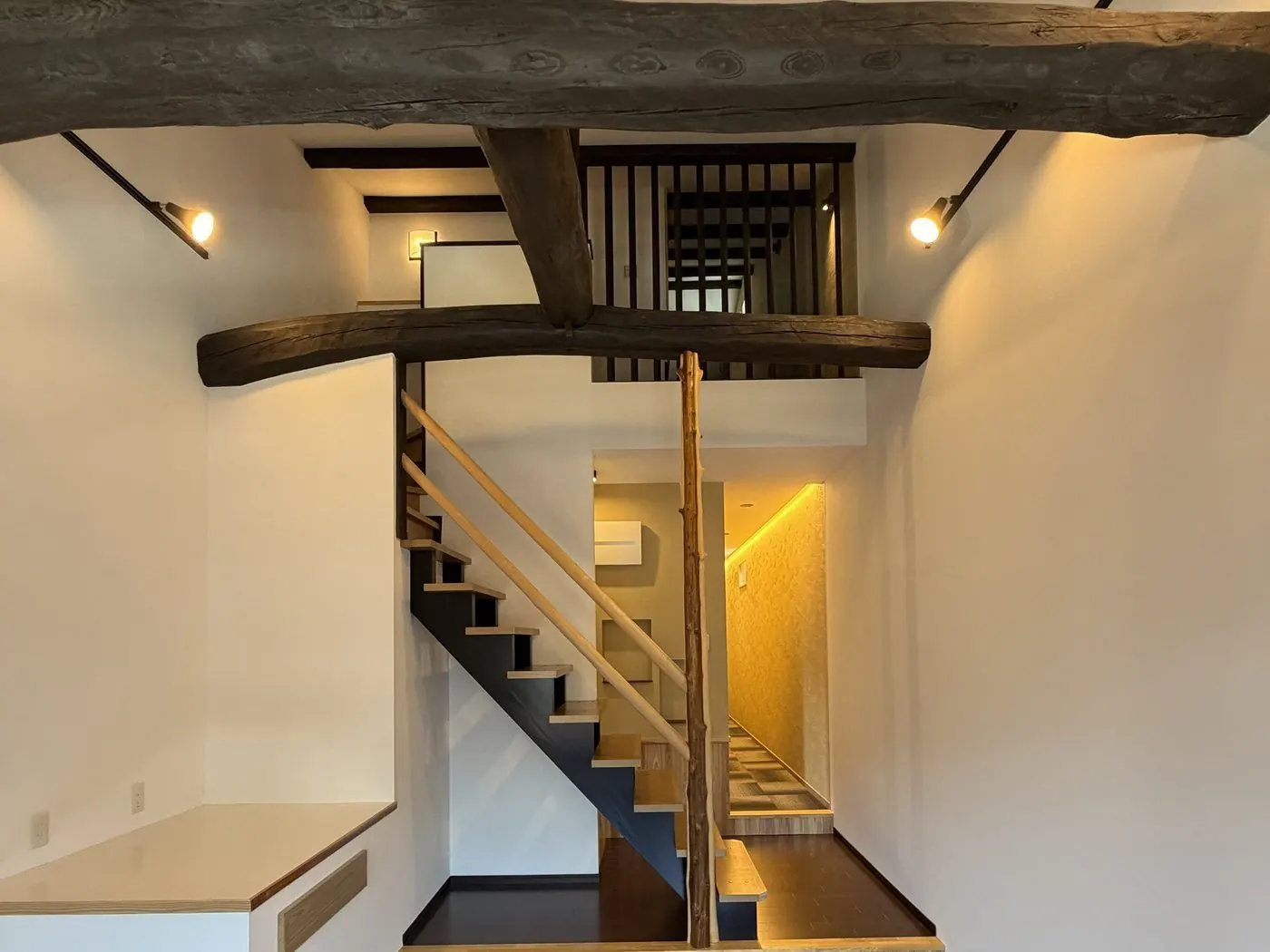
Repaired and opened as a guesthouse
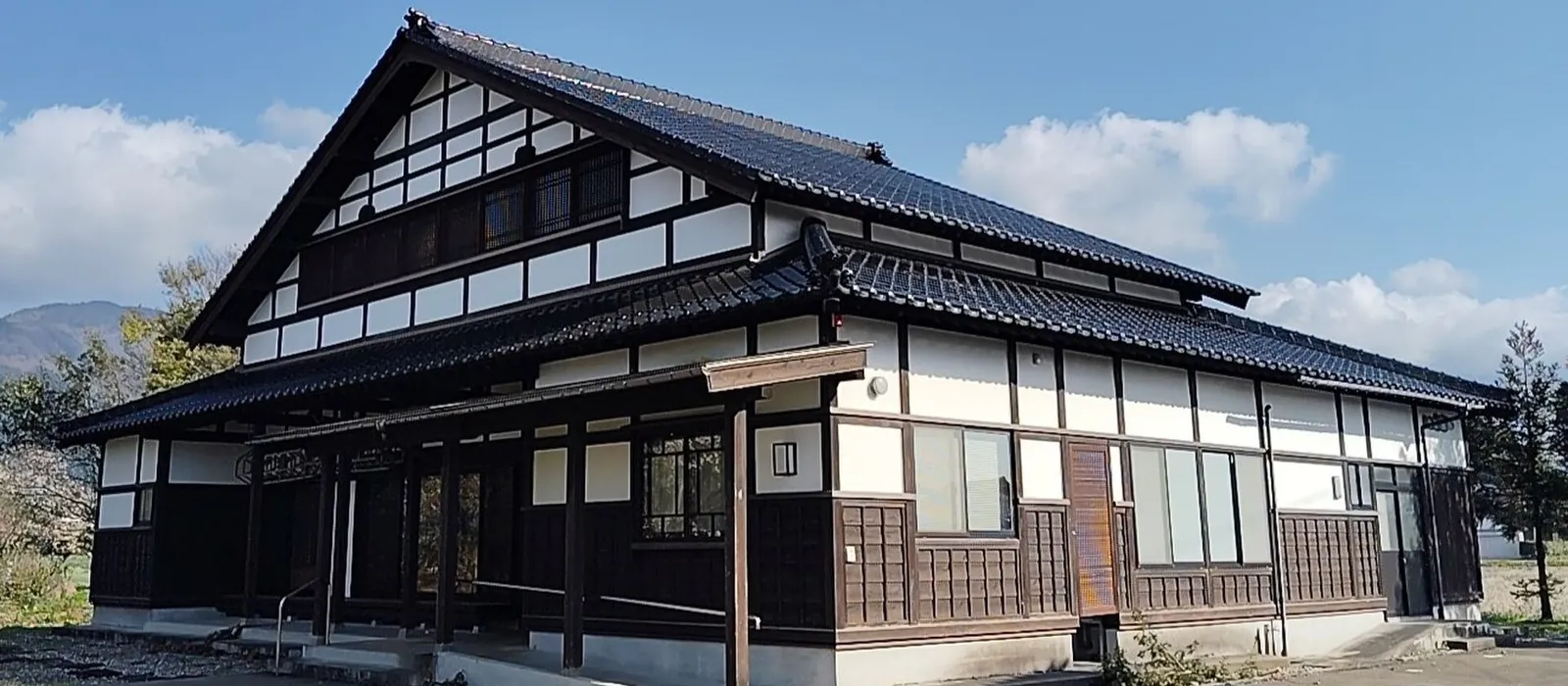
One of our kominka restorations. Even a tired Japanese-style room can go to the next user if the frame of posts and beams is sound. We removed the ceiling to expose the beams as a stairwell and opened it as a minpaku (private lodging). Four months of work, construction cost ¥9 million. → See this project in detail
Many people assume the house cannot be sold until the trees are cut and the place tidied. With us the order is reversed. We buy as it stands, trees overgrown, leaves piled up, contents still inside. Whether to fell, and which trees to keep, we decide after buying.
A comparison of a brokered or demolition-based sale with our direct purchase is in How we buy. If the seller pays for felling first to bring the site closer to cleared land, the price does not rise by that amount. The felling cost is best paid by whoever decides how the house will be used, and only as much as is needed.
No felling cost up front. We appraise with the trees as they are, building any need for felling or pruning into the figure
Trees that can stay, stay. The windbreak row and thick healthy trees are kept as value for the next occupant or a guesthouse. Dangerous trees are dealt with after we take over
No need to clear the contents either. The family altar can stay. We may ask you only to arrange the closing rite
From outside the prefecture is fine. We hold the key and check the site, and the contract goes by post. Handover as soon as two weeks after the survey
No liability for defects after handover. Dealings with the neighbours about the trees pass to us once the house is handed over
Our price is lower than a brokered sale would fetch, because we as the buyer take on the repair cost, the risk of not selling, and the work of clearing and tending the trees. In return, since we do not assume demolition, we deduct neither demolition nor felling cost from the price.
For those who don't want to sell and may someday return, there is another path: restore it and use it as a rental or an inn. We handle everything from business plan to design, construction and advice on tenants and management after handover. A house surrounded by its grove is chosen precisely because of the grove, both as a whole-house inn and by tenants who want country life. If it becomes an inn, we can manage it as a licensed vacation-rental manager. How much of the tree care to include is decided then. You keep the ownership, and the complaint calls stop.
How the city sees it. Before a complaint turns into a notice
A neighbour's complaint and a notice from the city office are not separate matters. The neighbour consults the city, the city inspects, and depending on the condition the house becomes subject to guidance as a poorly managed vacant house. This is a new category created by the amended Vacant Houses Act in force from 13 December 2023, allowing guidance and recommendations for a vacant house at risk of becoming a designated hazardous vacant house, before it gets there.
The Ministry of Land, Infrastructure, Transport and Tourism's guidelines on vacant houses at risk of mismanagement and designated hazardous vacant houses list example states that help with the judgment. Alongside a leaning building or a damaged roof, there's an item for standing trees: a tree rotted and fallen, or broken branches scattered widely over a nearby road or house; or branches overhanging a nearby road so that people on foot can't get past. In other words, trees alone can trigger guidance, even while the house itself is still standing solidly.
If guidance is issued for a poorly managed vacant house, nothing improves, and it proceeds to a recommendation, the lot loses the residential-land relief on property tax. The relief is diagrammed on the Demolition costs page; in short, the tax on the land goes up. The sequence is that neglecting the trees ends in the same tax bill as if you had demolished the house.
But the houses that get this far are almost always ones where the owner cannot be reached. A city rarely issues a recommendation out of the blue to an owner who has replied, handed over contact details and given a date. The four things in the first section work here too. What stage a letter from the city represents, and what to do by when, is set out in A notice about your vacant house from the city office.
FAQ
The neighbour cut our branches without asking. Can I say nothing?+−
Under the amended Civil Code Article 233, a neighbour may cut branches themselves if any of three conditions applies: the owner was asked and did not cut within a reasonable period, the owner cannot be identified, or there is urgent need. Cutting without any of these applying goes too far, but the fact remains that the branches were overhanging. Saying "I am sorry you had to do the cutting" and talking about your plans for future maintenance keeps the neighbourly relationship going. If the damage is serious, such as the tree itself being felled, consult a lawyer.
Can the neighbour bill me for cutting the branches themselves?+−
It's possible. If the neighbour cuts the branch off themselves, they can reportedly bill the tree's owner for the cost — that's how the Ministry of Justice explains it. But that only happens after, for instance, a formal request has gone unanswered. Reply once you're contacted, arrange to have the branch cut yourself, and you'll only pay a contractor of your own choosing.
If a tree in the grove falls and damages the neighbour's house, who is liable?+−
As a rule, the tree's owner. Civil Code Article 717 makes the owner liable for damage caused by a defect in how trees or bamboo were planted or supported. If it emerges that a dead or leaning tree was left standing, the liability is heavier. Fire insurance on the vacant house may cover damage to your own building, but compensating the neighbour is another matter. Deal with leaning and dead trees first. Liability on the building side (sliding snow, tiles, a collapsing kura) and what to check in your insurance are in Who is liable when a vacant house damages the neighbours.
I want to let the rice fields go as well.+−
Talk to us about the house lot and the grove as they stand. Rice fields are farmland, which needs the agricultural committee's permission and follows different procedures from a house lot. Sometimes we can take them and sometimes not; we answer after checking the registered land category. The three routes for farmland are in Selling a family home with rice fields or forest.
Bamboo is spreading into the neighbour's land. Is it treated like branches?+−
Bamboo spreads by rhizomes (roots), so it is treated differently from branches. Under Article 233(4), roots that cross into the neighbour's land may be cut without any prior request. In other words, the neighbour can cut the rhizomes on their side at any time. But once bamboo has spread it is hard to eradicate, and bamboo that keeps coming up next door is itself a cause for complaint. A house with a bamboo grove attached can also be discussed as it stands.
Will I get more if I fell the trees before selling?+−
When selling to us there is no need to fell first. We appraise with the trees as they are, building any need for felling or pruning into the figure. Paying for felling in advance does not raise the price by that amount, and trees that can be kept are kept as part of the value of a guesthouse or home. Decide after putting a felling quote and our appraisal side by side.
I live in another prefecture and don't know how to reach the neighbours. Who should I contact?+−
The neighbourhood association head first. If you do not know who that is, ask relatives or your parents' acquaintances near the house, or the vacant-house desk at the city office. Give the association head your contact details and they will reach the neighbours. If you consult us, we do the site check and report with photos.
This page is a general explanation of the rules. Whether overhanging branches may be cut, who bears the cost and how far liability for a fallen tree extends depend on the individual case. Confirm the final position with a lawyer or judicial scrivener. Rules are as of September 2026, and the official guidance of the Ministry of Justice, MLIT and each city takes precedence. City support schemes change each fiscal year.
Before you cut the trees, know what the house is worth with them.
A few photos of the outside of the house and of the trees. Contents still inside, trees overgrown, from another prefecture is fine. Appraisal is free, and declining costs nothing.