Read before you sell / A house with a neglected leak

A house where a leak was left alone can still be sold. The order the damage goes in, and the line between repairing and selling as it is

A family home where a leak has been left for years can still be sold. What changes is the price, and who is responsible after handover.

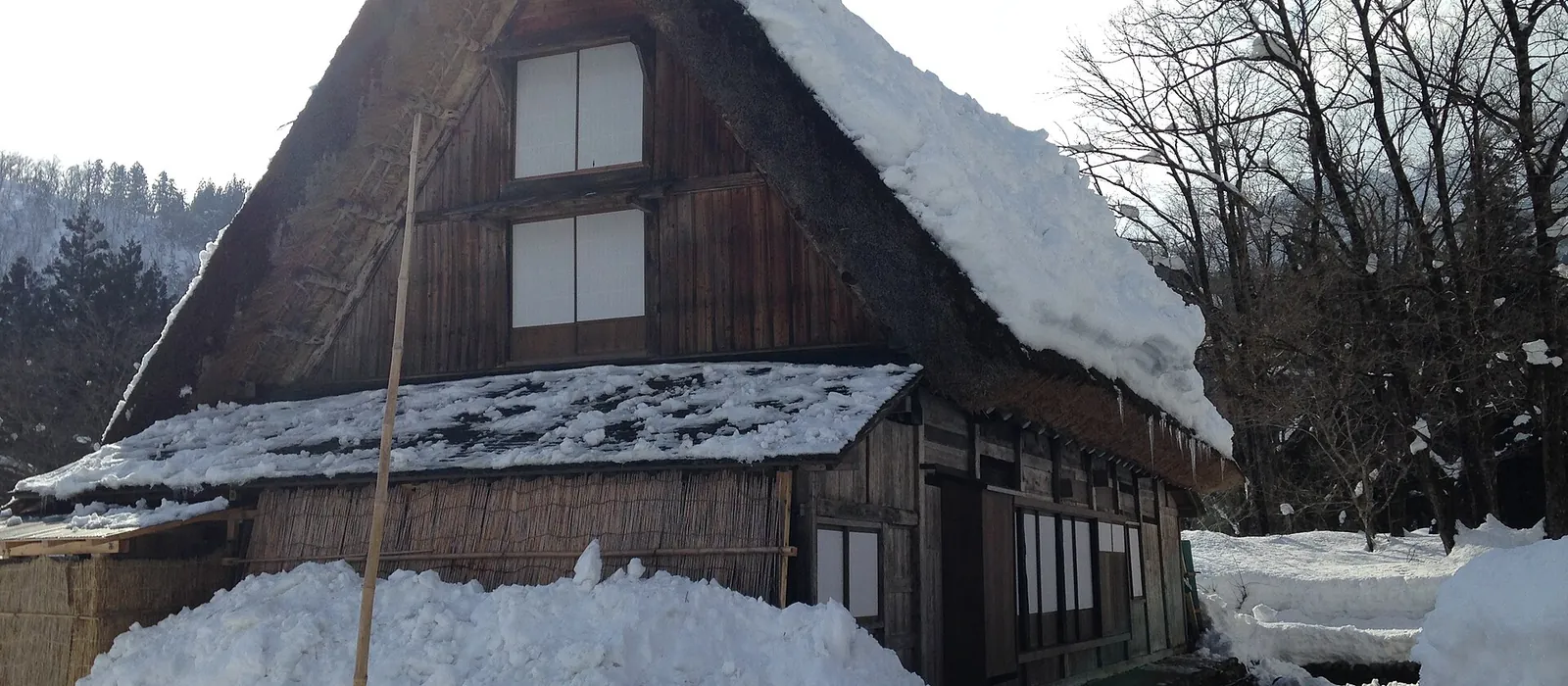
A thatched roof under snow (Gassho-zukuri Minkaen, Shirakawa-go)A gassho-zukuri farmhouse with thick snow on its great thatched roof and snow jutting out from the eaves (Shirakawa, Gifu)
Photo: そらみみ "Asano Chuichi Family Residence"(CC BY-SA 4.0), cropped
1 Just send photos of the ceiling stains and the roof space. We first assess whether it can be sold unrepairedFree appraisal on LINE 2 9:00–17:00, Japanese only / after 17:00: Call us
1970Founded / Yatsuo, Toyama City
Real estate + constructionA builder with both a real estate licence and a construction permit
Appraisal and survey: ¥0No charge if you decline
Toyama, Ishikawa and HidaOwners living elsewhere welcome

A leaking house can be sold. What changes with how you sell is who is responsible

Through an agent Selling to us Buyer Someone who will live there A builder who will repair it Before the contract Seller discloses the leak Agent explains important matters (Brokerage Act arts. 35, 47) We look at the roof surface and roof space We buy knowing how far the damage goes After handover Seller keeps liability for defects Civil Code art. 562 on. Notice within a year of discovery, and repair, reduction or cancellation can be demanded Liability for defects waived Repair cost is carried inside our price Waiver clause Facts known and not disclosed are not covered, clause or not (Civil Code art. 572) We ask you to tell us everything you know So the waiver is a promise that holds for both sides Because we buy in order to repair, the waiver after handover holds for both sides
Through an agent, disclosure and liability for defects stay with the seller. When we buy, the repairer checks the house and buys, so liability after handover can be waived.

A leak does not stop a house selling. What changes is the price and who is responsible after handover.

There are two main ways to sell a house: through an estate agent to someone who will live there, or as it is to a buyer like us. For a leaking house, the two put responsibility in completely different places.

Selling through an agent. The buyer is someone who will live in the house. If the seller knows about a leak, it must be disclosed to the buyer. The estate agent handling the sale is bound by law to explain the important points before the contract, and must not deliberately hide them (Real Estate Brokerage Act arts. 35 and 47). The same applies even when the seller is an individual. Sell without mentioning a leak, and the house is treated as “different from what was agreed.” The buyer can demand repair or a lower price, and can even demand the contract be cancelled. This is liability for defects under Civil Code art. 562 onwards, and the buyer can pursue it by notifying within one year of discovering the defect (art. 566).

You will sometimes hear, “Just add a waiver clause.” In a private sale, you can agree a clause excluding liability for defects. But something the seller knew and did not disclose is a different matter. Even with a promise not to be liable, the seller is still liable (Civil Code art. 572). Knowing about a ceiling stain and saying nothing. Taking down the blue tarp before a viewing so it looked like nothing was wrong. A waiver clause does not protect a sale made that way.

Selling to us. The buyer is not someone who will live there but a builder who will repair it. At the site survey we look at the roof surface and the roof space, see for ourselves where the water gets in and how far the damage goes, and buy knowingly. That is why, when we buy, liability for defects after handover can be waived: the cost of fixing the leak is carried inside our price.

One request. Tell us everything you know: since when, which rooms, in heavy rain or in the thaw. We ask you not to hide anything, not because we fear losing money, but to make the waiver a promise that holds for both sides. If we price the house after hearing it all, there is nothing left to reopen later.

A leak is not a roof story but a frame story

1 2 3 4 5 Ceiling stain = where the water comes out The way in is not necessarily directly above 1 Tiles and flashing ─ the way in Usually starts at the valleys and ridge 2 Roof boards ─ under the tiles Wet and dry over and over, the boards warp 3 Roof framing ─ the bones holding the roof Rafters, purlins, beams. Water runs along the timber downhill and pools on top of the beams 4 Post heads ─ where ceiling stains appear Water pools in the joints and the post heads rot 5 Sill ─ the foot Down inside the wall to the foot. Damp timber is what termites like Stages 1–2: roof repair. Stages 3–4: replace roof framing. Stage 5: structural repair. Repair cost and our price are both decided here
Rainwater gets in on the roof and travels down through the roof boards, roof framing and posts to the sill. A ceiling stain is the exit of that path; the way in is usually somewhere else.

"Leak" brings to mind a hole in the roof with water dripping through it. It is not like that. Rainwater gets in on the roof, travels through the timber and shows itself a long way off. A ceiling stain is only the exit of the path the water took.

The order the water travels in is more or less fixed.

1. Tiles and flashing ─ the way inShifted or cracked tiles, plaster flaking off the ridge, joints in the flashing. In a Hokuriku house it usually starts at the valleys where two roofs meet and at the ridge on top. If it is only here, it is a roofer's job and the cost is small.
2. Roof boards ─ under the tilesUnder the tiles are the underlay and the roof boards. Once water gets round them, they get wet and dry over and over, the boards warp and lose their grip on the tiles. By this point, putting the tiles back will not stop it.
3. Roof framing ─ the bones holding the roofBelow the roof boards are the rafters, the purlins (the horizontal timbers that carry the rafters) and the beams. Water runs down the surface of the wood to the lowest point and pools on top of the beams. Look into the roof space at this stage and you will see patches turned black, or white mould.
4. Post heads ─ where ceiling stains appearWater collects in the mortise joints where beams meet posts, and the post heads start to rot. A ceiling stain is water that dropped somewhere in stages 1 to 4 and soaked into the ceiling board, so the way in is not necessarily directly above the stain. That is why our site survey looks at both the roof surface and the roof space.
5. Sill ─ the footWater that has run down the posts travels inside the walls to the sill. The floor sinks, the tatami goes mouldy, the back of the closet is damp. At this point it is structural work, not roof work. Damp timber is also what termites like, and the sequence in which a neglected leak invites termites starts here. What comes next is in Can a termite-damaged house be sold or repaired?.

In other words, when you tell us about a leak, what we want to know is not “how big is the hole in the roof” but how far the water has advanced through these five stages. Stage 1 or 2 damage means a roof repair is enough. Stage 3 or 4 means replacing part of the roof framing. Once it reaches stage 5, the structure itself — posts and beams, the parts that hold the house up — needs repair. Both the repair cost, and our offer if you sell without repairing, are decided here.

Three stages, depending on how many years it has been left

The stages a neglected house goes through (not decided by years) Stain stage Signs Ring stains on ceiling boards Mould on a closet ceiling Drips only in heavy rain Restore Seal the way in and it stops From a few hundred thousand yen Sell Through an agent or to us Fallen-ceiling stage Signs Ceiling boards give way and sag Damp tatami, spongy floor Years under a blue tarpaulin Restore Part of the roof framing and the interior Sell Hard to find a buyer through an agent We appraise on the basis of repairing Rotting-post stage Signs Post heads and sill rot The house starts to lean Termites move in Restore Structural repair Most costly and lengthy Sell If the frame is sound, we can buy The further the stage, the further away the route of repairing and selling through an agent Our purchase stays open (the price falls by the extra repair cost) Speed depends less on years than on how much water got in and how long it took to dry. An empty house with no ventilation is fast
It is not "too late after so many years": how far the water has gone decides how to repair and how to sell. The price falls with each stage, but if the frame is sound, we can buy.

We are often asked, “After how many years is it too late?” Honestly, it is not a matter of years. It is decided by how much water got in and how long it took to dry. Nobody lives there and nobody opens a window to let air through, so a vacant house never gets the chance to dry, and the damage moves faster. Even so, the stages break down into roughly three.

  • The stain stage. Ring stains on ceiling boards, mould on a closet ceiling, drips only on days of heavy rain. The water has usually stopped in the roof space, and finding and sealing the way in stops it. Our spot repairs cover this stage from a few hundred thousand yen. You can sell through an agent or to us
  • The stage where the ceiling comes down. Ceiling boards soak up water, give way and sag. The tatami is damp and the floor is spongy. A house that has sat under a blue tarpaulin for years is here. Part of the roof framing and the interior below it need repair; roof work alone will not cover it. Buyers through an agent are harder to find, but we appraise on the basis of repairing, so a price is still possible at this stage
  • The stage where posts and beams rot. Post heads and sill rot and the house starts to lean. Termites, which like damp timber, move in and the damage spreads. This is structural repair, the most costly and lengthy. Even so, a Hokuriku house framed with thick beams and posts can usually be saved by replacing only the damaged members. Whether the frame is sound is what we check on site

The further the damage has progressed, the harder it is for the seller to repair it themselves and sell through an agent. On the other hand, we can take on the house however far the damage has gone. That is the important part. But the price falls, because the more the repair cost rises, the more we are taking on. “While it’s still just a stain” is not a sales pitch — it is the price calculation itself.

If the house has started to lean, there are things to look at apart from the leak. Causes and fixes are in Can a leaning house or kominka be repaired?, and how to tell a repairable house from one that is not, leaks and all other damage included, is in Will you buy a damaged house?.

Toyama leaks come from snow, not rain

Icicles at the eaves (Aomori City)The eaves of a building with roof snow jutting out and a row of icicles hanging beneath (Aomori City)
Photo: あおもりくま "屋根からせり出した雪庇 P2010028"(CC BY-SA 3.0), cropped

Someone living outside the prefecture pictures a leak as a typhoon or rainy-season thing. Toyama is different. The damage we go in to repair in vacant houses is concentrated in winter and spring, and it is freezing and snow more than rain. Even the leaks themselves mostly come from snow.

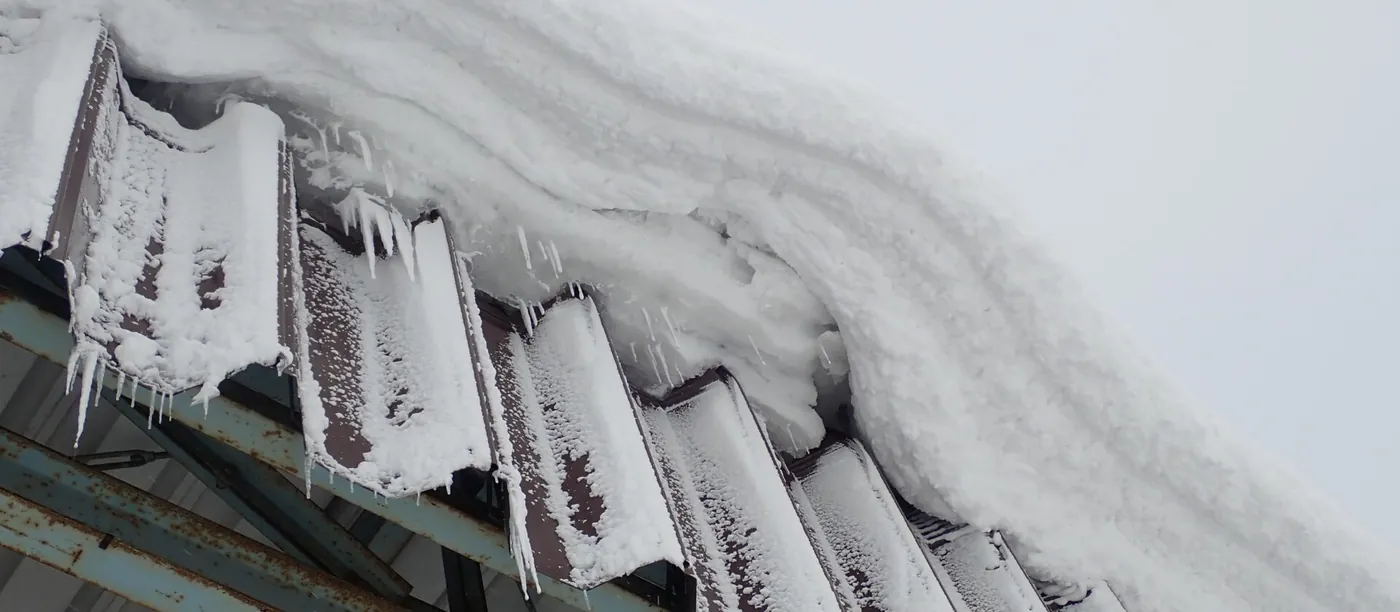
Snow freezes and thaws on the roof. Snow on the roof melts from below, from the sun on a clear day and the little heat from inside the house. The meltwater runs down the roof and freezes again at the cold eaves. An ice dam forms, the water pooled behind it has nowhere to go and works its way under the tiles. A roof that would simply shed rain holds water back when it is snow. This is why a Toyama vacant house can leak with no tile out of place.

Falling snow breaks the gutters and eaves. Snow that slides off all at once on a warm day breaks the eaves, the gutters and the neighbour's fence. Once the gutter is off, water from the roof runs down the wall and into it. When we hear in spring that the eaves have come down, this is usually the order.

Snow blows in through windows without snow screens. When the family lived there, they put snow screens on the windows and garden trees every autumn. Once the house is empty and the screens stop, driving snow gets in through the gaps around the windows and wets the timber under the sash. A leak that starts at the window, not the roof.

It breaks in winter and is noticed in spring. Only when the snow is gone can you see the shifted tiles, the detached gutter, the warped eaves. If you can only come back once a year, whether you can look in March or April, after the thaw, changes how far the damage goes that year. What happens month by month is in the year-round calendar for managing a Toyama vacant house from afar; how the roof itself is repaired and protected from snow is in The roof and snow.

The real cost of repair, and why we do not recommend repairing before you sell

A Repair, then sell through an agent B Stop the leak only, sell through an agent C We buy as it is Seller's cost Re-roofing ¥2–4.5 million + ceiling and tatami interior From a few hundred thousand yen (sealing the way in) ¥0 No brokerage fee either, no clearing out Time Work, plus listing to completion Repair, plus listing to completion from the site survey Handover in as little as 2 weeks Disclosure and liability Disclosure remains Liability for defects remains too Damage to the roof framing remains, so disclosure is needed After handover, Liability for defects waived Price Repair cost does not necessarily go straight onto the sale price Buyer plans to live there, so it becomes grounds for haggling Our price is lower than an agent's Repair cost and the risk of not selling are ours to carry Whichever route, the first step is the same: find out what the house fetches sold as it is
Repairing before you sell versus selling as it is. Our price is lower than an agent's, but we take on all of the cost, the time and the responsibility.

As we also repair roofs, we have no reason to hide what repair really costs. Here are the numbers first. All are construction costs, and vary with floor area, roof shape and scaffolding conditions.

  • Spot repair (sealing the way in, patching flashing, etc.)from a few hundred thousand yen
  • Re-roofing (tiles, snow measures)¥2–4.5 million
  • Seismic reinforcement (walls, hardware, foundation)¥2.5–7 million

Switching from tiles to a lighter roofing when you re-roof gives more margin against the weight of snow and helps in earthquakes at the same time. Roof work needs scaffolding, so doing the outer walls and gutters at the same time gets more for the money. Our order when repairing a house is roof, structure, insulation, plumbing, interior. Finish the interior before the roof and the leak stains the ceiling you have just finished.

So, should you repair before selling? As a rule, we advise against it. Three reasons.

1. The repair cost does not necessarily go onto the sale priceSpend ¥3 million re-roofing and the buyer does not pay ¥3 million more. What the buyer looks at is not how new the roof is but whether they can live in the house, and the going rate around it. With a new roof but an old ceiling and tatami, it is still seen as a house that needs renovating.
2. Stopping the leak does not remove the duty to discloseSeal the way in for a few hundred thousand yen, and the fact that the roof framing got wet and discoloured remains. Selling through an agent, you disclose it. "Repaired" and "undamaged" are different things, and buyers look at that.
3. The time for the work and the time to sell both add upRoof work needs time for design, quoting and construction. Then you list the house and wait for a buyer. All the while, property tax and management costs continue (upkeep of a vacant house is roughly ¥150,000–400,000 a year).

Our purchase is those three turned around. The seller's cost is zero, and there is no brokerage fee. Handover in as little as two weeks from the site survey. No clearing out, and liability for defects after handover is waived. In return, our price is lower than a brokered sale would fetch, because we, as buyer, take on the repair cost, the risk of not selling and the clearing out. We do not hide that.

For some people, repairing before selling is the right route. Those whose family may go on living in the house, or who want to sell through an agent even if it takes time. Then we help as the contractor doing the work. The overall costs are in renovation costs. Whichever route, the first step is the same: find out what the house fetches sold as it is. Only with that number can you work out whether ¥3 million of work pays.
Selling as it is: the steps from photos to handover, in as little as two weeks

How it goes when you sell a leaking house to us as it is. If you live outside the prefecture, it can be done with no trips home, or one.

1. Send photos and the locationOn LINE, send photos of the ceiling stains, the roof space and the back of a closet, plus where the house is (how to shoot them is in the next section). Contents in place and tarpaulin on is fine. We accept at this stage even if the inheritance registration is not done or you are still talking it over with your siblings.
2. We send back a rough figureFrom the photos we estimate which of the five stages the water has reached and give you a rough range. If it looks beyond repair, we say so honestly, with the reason.
3. Site survey (free)We visit and look at both the top of the roof and the roof space. If you live in another prefecture, we hold the key and report with photos and video. Please do not hide the leak.
4. The figure, in writingWe give you the figure and the reason (how much we have allowed for repair) in writing. There is no charge if you decline, and as a rule we contact you once only.
5. Contract, registration, handoverThe contract can be exchanged by post. If the inheritance registration is not done, our partner judicial scrivener completes it before handover (inheritance registration has been compulsory since April 2024). Handover in as little as two weeks from the site survey. The contents and the altar can stay. For a Buddhist or Shinto altar we may ask you only to arrange the closing rite.

After handover, that leak is our job. You will not be looking for a roofer or hearing from a buyer. For the procedures and taxes after a sale, see the guide to selling an inherited house and the ¥30 million special deduction for vacant houses; for doing it without coming back, see how to sell without coming back.

Three photos tell us: ceiling stains, the roof space, the back of a closet

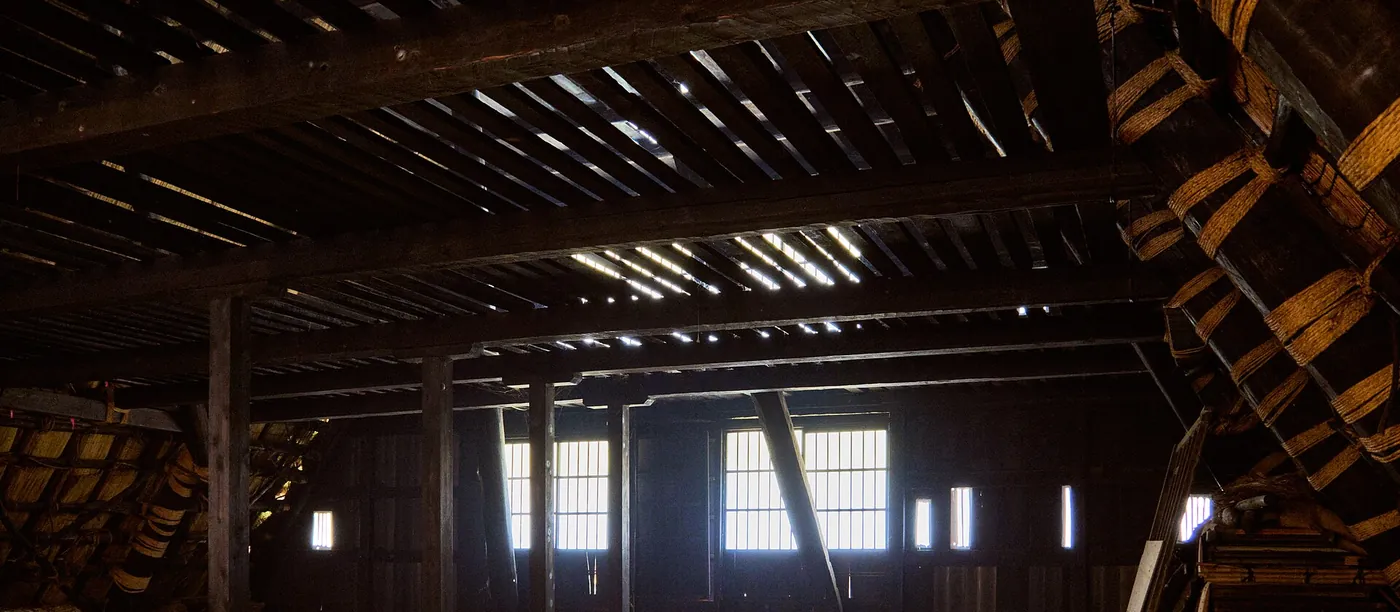
Beams and roof boards in a roof space (Hida Folk Village, Takayama)The roof space of a kominka with thick beams and rafters; light comes through the gaps in the roof boards in streaks
Photo: lumoplank "Hida Folk Village 6448"(CC0), cropped

Before we visit, three photos give a rough idea of which of the five stages the water has reached. They need not be good photos. If it is dark, turn on your phone's light; blurred is fine.

  • Photo 1, the ceiling stains. The ceiling of a stained room, from the doorway so the whole ceiling is in. We look at how many stains there are and how far they spread. If a ceiling board sags or has fallen, add one close-up of that spot
  • Photo 2, the roof space. Slide aside a ceiling board in a closet, or use the ceiling hatch, and shoot towards the underside of the roof. Blackening on top of the beams, white mould, and any spot where light comes through (that is the way in) are enough. If it is unsafe to climb up, just reach in with the camera
  • Photo 3, the back of a closet. Open the closet in the stained room and shoot the back wall and the corner of the floor. If it is damp, mouldy or the floorboards are black, water has come down inside the wall to the foot. This tells us whether it is near stage 5, from post head to sill

If you can, add a shot of the house from the road and one that shows the roof. Disturbed tiles, a sagging ridge and a detached gutter can sometimes be seen from outside. But whether a house leaks cannot be settled from the outside alone.

Sending photos is not only for the appraisal. It is also so that you know for yourself which stage your house is at. Whether you sell through an agent or repair and live there, these three photos are the first thing you need.

What happens to the house after we buy it

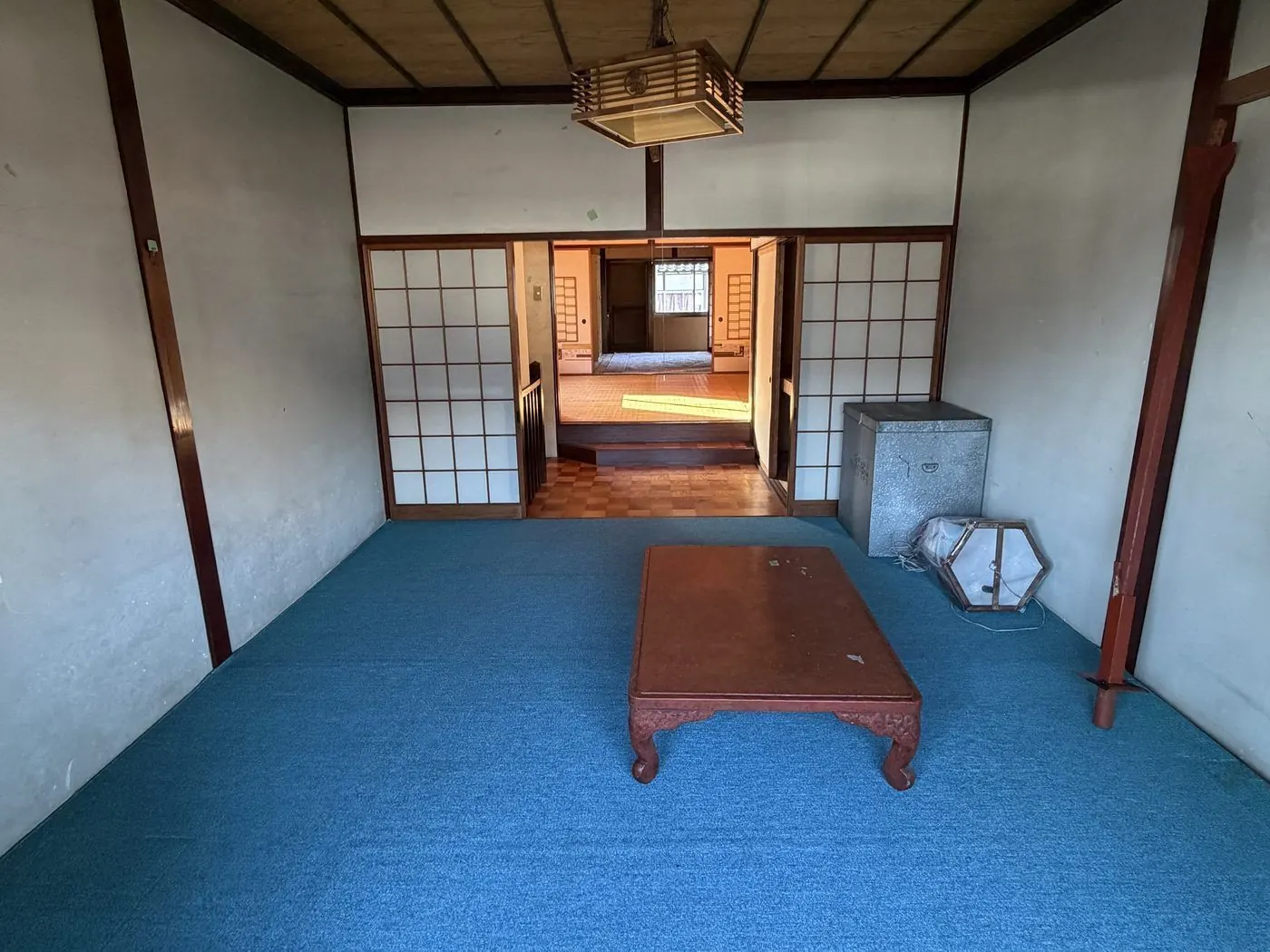
Tatami room before renovation (our project)Kominka turned into a guesthouse: the tatami room before renovation
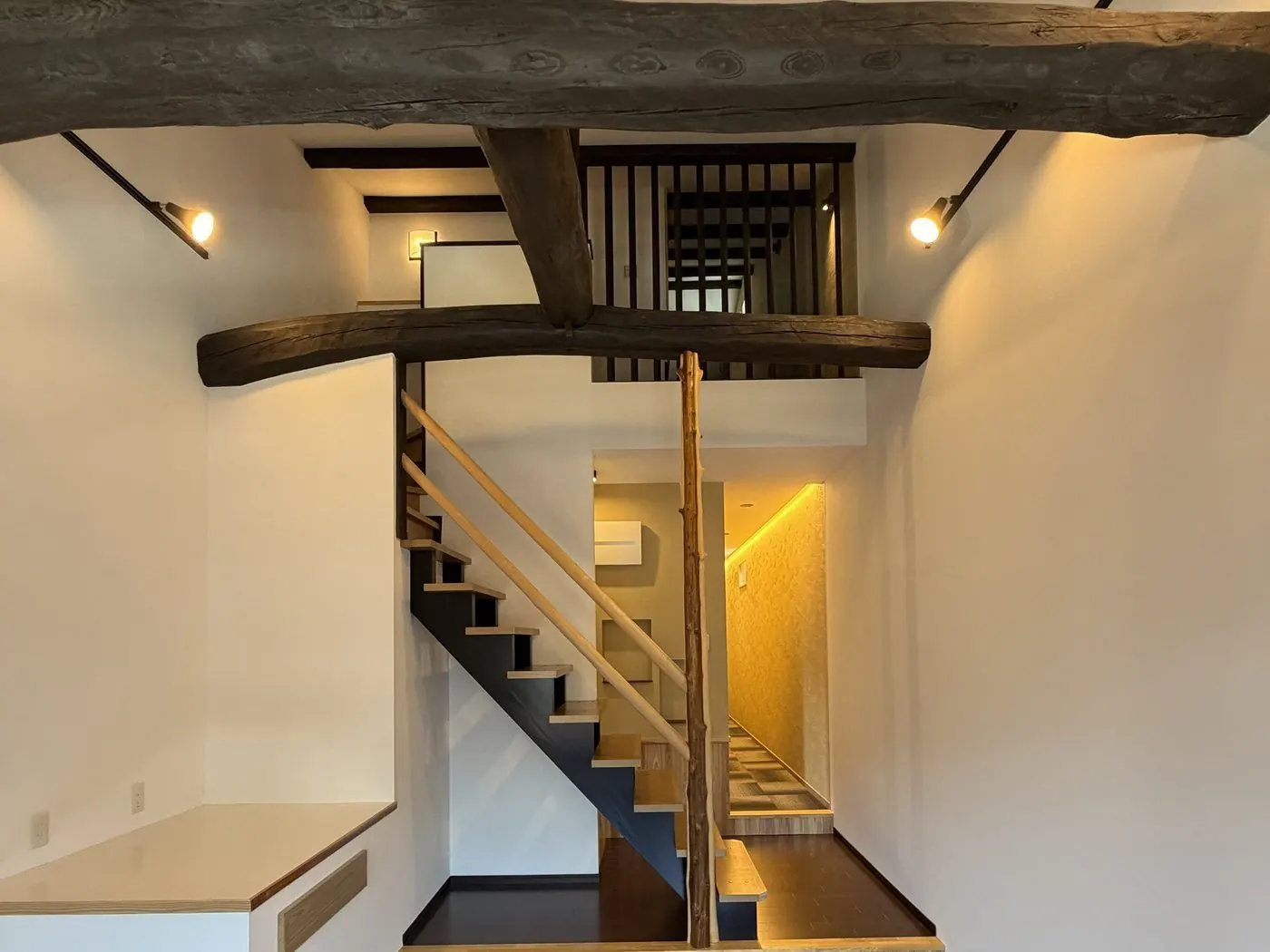
Repaired and passed on to the next userKominka opened as a minpaku guesthouse: the stairwell with exposed beams (after)

One of our kominka restorations. Even a tired Japanese-style room can go to the next user if the frame of posts and beams is sound. We removed the ceiling to expose the beams as a stairwell and opened it as a minpaku (private lodging). Four months of work, construction cost ¥9 million. → See this project in detail

We do not demolish the houses we buy. We repair the roof, replace damaged timber, add insulation and seismic reinforcement, and hand the house to its next occupant. We buy leaking houses because we intend to repair them. A buyer who demolishes and clears the site deducts the demolition cost from the price, and the worse the leak, the less the house is worth to them.

One example: a 90-year-old former farmhouse with a storehouse in Takaoka that we bought. Empty for ten years, with a leak, damaged floors and a great deal left inside, the owners had no idea where to start. We bought it as it was, belongings and all, and took the furniture and tools they could not dispose of. "We should have asked sooner" were the couple's words (what our clients say).

We are not here to blame you for leaving the leak. You live outside the prefecture, have no money set aside for repairs, and your siblings do not agree. Years go by; that is entirely normal. But water does not wait. Find out the price now, while the house still has one. That, we think, is the order that loses you least. How we repair a Toyama house from the frame out is in the Toyama kominka restoration guide.

FAQ

Will you buy a house whose ceiling has come down?+−

Yes, talk to us. A fallen ceiling is a sign that water has reached the roof framing, so we go into the roof space and check how far the beams and post heads are damaged. If the frame is sound, replacing just the damaged members is usually enough, and we can buy. Our price is lower by the cost of repair, but you do not need to clear anything or do emergency work. If it is the roof itself, not the ceiling, that has come down, see What to do with a house whose roof has fallen in or that looks about to collapse.

The blue tarpaulin is still on. Can I sell it like that?+−

Yes, and please do not take it off. The tarpaulin marks where the water gets in, and at the site survey we look at the tiles and roof boards beneath it. There is no need to remove it to show us before selling; that would only lengthen the time snow and rain get in. If you can tell us when it went on and which rooms showed stains before that, our assessment is quicker.

The tatami has gone mouldy and the whole room smells. Should I clear it out before I ask?+−

No clearing out needed. Mouldy tatami and damp contents we dispose of after buying. What we want to see first is under the tatami. Damp tatami means either water has come down the walls to the floor, or damp is rising from underneath, and the repair differs. A photo of the floorboards with one tatami mat lifted helps, but if that is not possible we look at the site survey. Where the contents are piled high, the order is set out in Selling a cluttered family home without clearing it.

I'm outside the prefecture and can't visit. Can you tell from photos alone whether it leaks?+−

Roughly, yes. Ceiling stains and discoloured posts in the roof space usually tell us, and with three photos (ceiling stains, roof space, back of a closet) we can estimate which of the five stages the water has reached. But water travels to unexpected places, so the way in is not necessarily directly above the stain, and the outside alone cannot confirm whether a house leaks. At the site survey we look at both the roof surface and the roof space.

Can fire insurance pay for leak repairs?+−

In general terms: fire insurance often includes cover for wind, snow and hail damage, so a leak caused by a roof broken by strong wind or the weight of snow may be covered. A leak from long-term wear and tear generally is not. If you have not told the insurer the house is vacant, a claim may also be refused. Whether it applies depends on your policy, so check with your insurer, having told them the house is vacant. Our purchase goes ahead whether or not you use insurance.

The neighbour has complained that tiles look about to fall. The city has sent a notice too.+−

Even for a vacant house, managing the building is the owner's responsibility. If falling tiles or snow harm a neighbour or a passer-by, the owner can be held liable. A municipal notice is usually the advice-and-guidance stage for a poorly managed vacant house; left alone it moves to a formal recommendation, and the residential land relief on property tax can be lost. Check the exact conditions with your municipality. From emergency covering to purchase, we look at the site first and then propose an order. If you contact us as soon as the notice arrives, we can move quickly. Liability is explained in Who is responsible when a vacant house damages the house next door, and the stages and deadlines of a notice in When the city sends a notice about your vacant house.

What happens if I sell through an agent without mentioning the leak?+−

The buyer can demand repair, a price reduction or, in some cases, cancellation of the contract on the grounds that the house does not conform to the contract (Civil Code art. 562 onwards). The buyer can pursue this by notifying you within one year of discovering the defect. Even with a clause excluding liability for defects, the seller is not released from facts they knew and did not disclose (Civil Code art. 572). When we buy, we have confirmed the damage ourselves at the site survey, so liability for defects after handover is waived. That rests on you telling us everything you know.

→ All 49 questions on selling and renovation

This page is a general explanation. Damage progresses differently in every building, and the scope of liability for defects and disclosure depends on the individual contract and circumstances. Check legal questions with a judicial scrivener or lawyer, and fire insurance cover with your insurer. Cost guides are our construction costs as of September 2026.

Before you repair, find out what it fetches unrepaired.

Ceiling stains, the roof space, the back of a closet. Three photos and the location are enough. Contents in place, tarpaulin on, from anywhere. Appraisal is free, and there is no charge if you decline.

Send photos on LINE Use the form
By phone (Japanese only) 9:00 - 17:00 After 17:00, site manager (Japanese only)

If you have decided to repair and use it.

The roof and snow, cost guides, managing from afar. The repairer's side of a leaking house is covered here.

The roof and snow ─ re-roofing and lighter roofs → Renovation costs → Managing a vacant house from afar: the year-round calendar → What to do with the family home ─ three routes →

Written by Tatsumasa Nakamura, Hokuriku Homes Updated

Phone9:00–17:00 LINEAppraisal from photos Free appraisalTakes 1 minute
LINEChat