Read before you sell / Selling or repairing a termite-damaged house
Termite damage or not, some houses can be repaired and some cannot. Reading a family home with a collapsed floor, and selling without treatment
If the damage stops at the sill and the foot of the posts, the house can be repaired. It can also be sold without treatment or clearing. Here is how to tell where the line is.
In Hokuriku the Yamato termite dominates. It starts from a damp sill and the plumbing
If it stops at the sill and post feet, splicing repairs it without demolition
We buy as-is with no treatment or clearing. No liability for defects
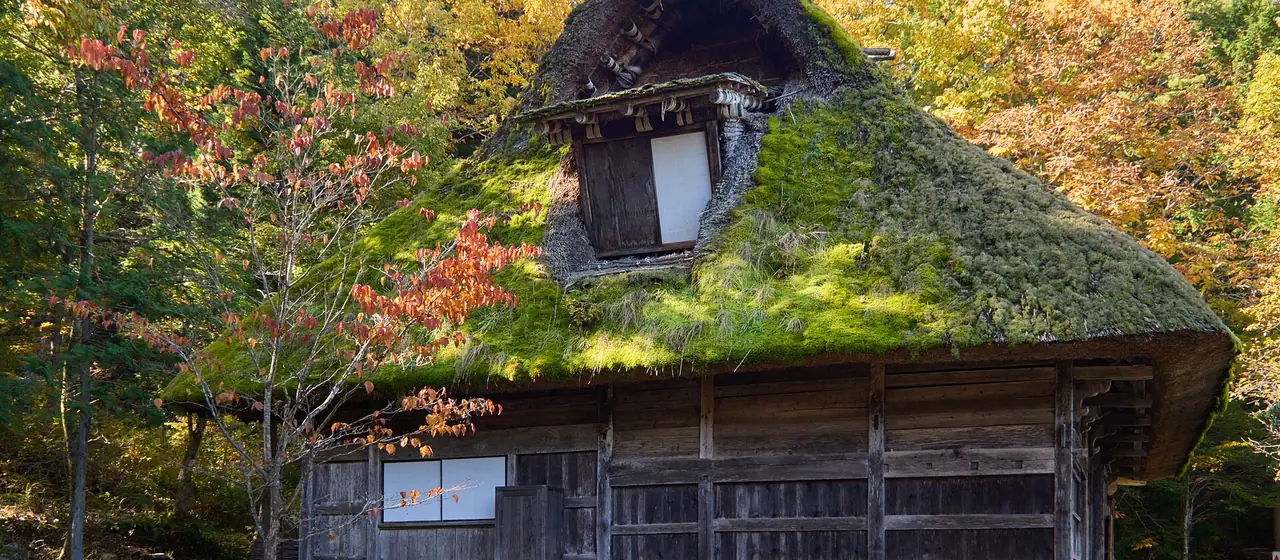
A moss-covered thatched roof (Hida Folk Village, Takayama)
Real estate + constructionA builder with both a real estate licence and a construction permit
Appraisal and survey: ¥0No charge if you decline
Toyama, Ishikawa and HidaOwners living elsewhere welcome
We buy houses with collapsed floors. No treatment, no clearing out needed
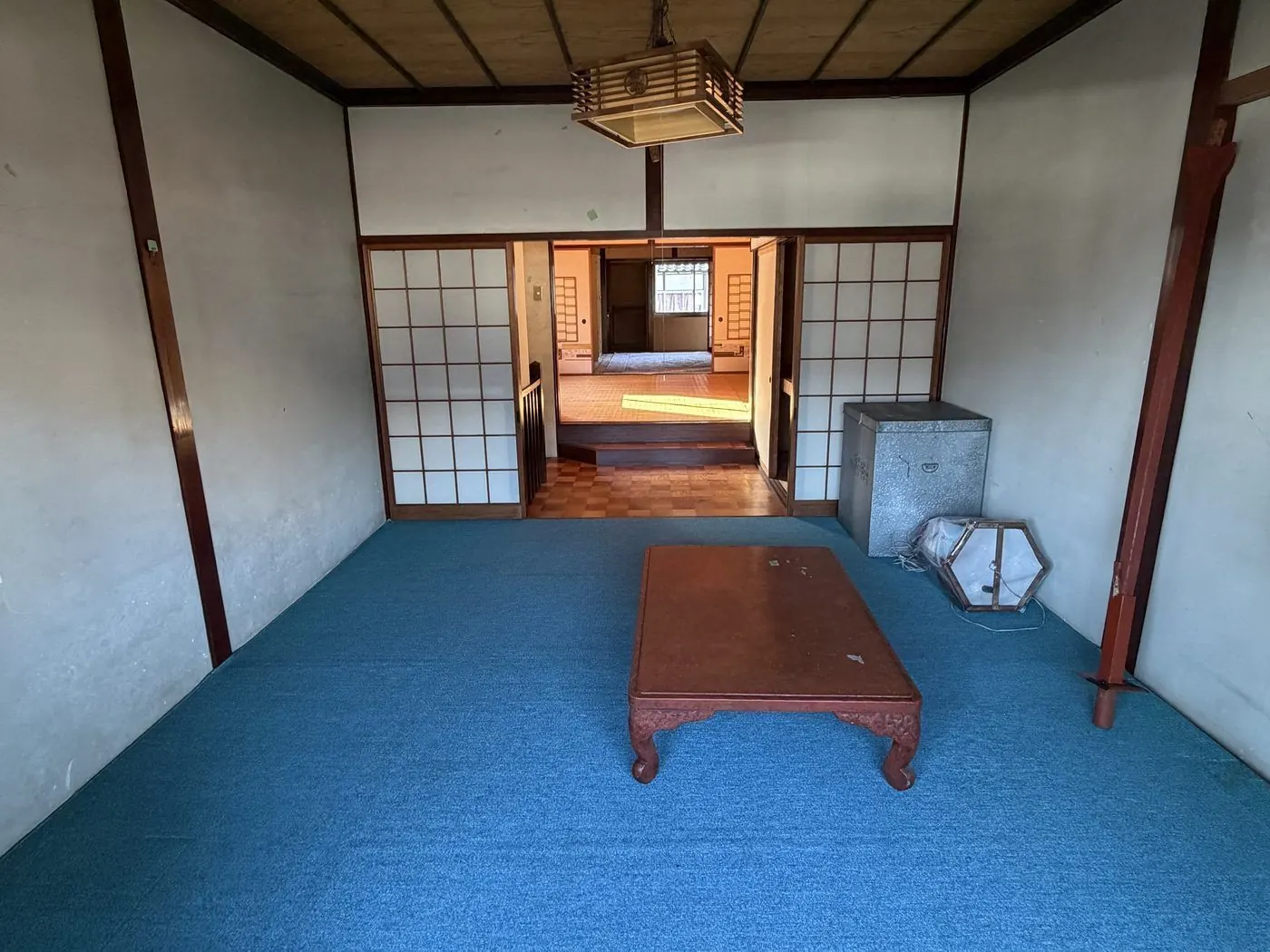
Tatami room before renovation (our project)
→
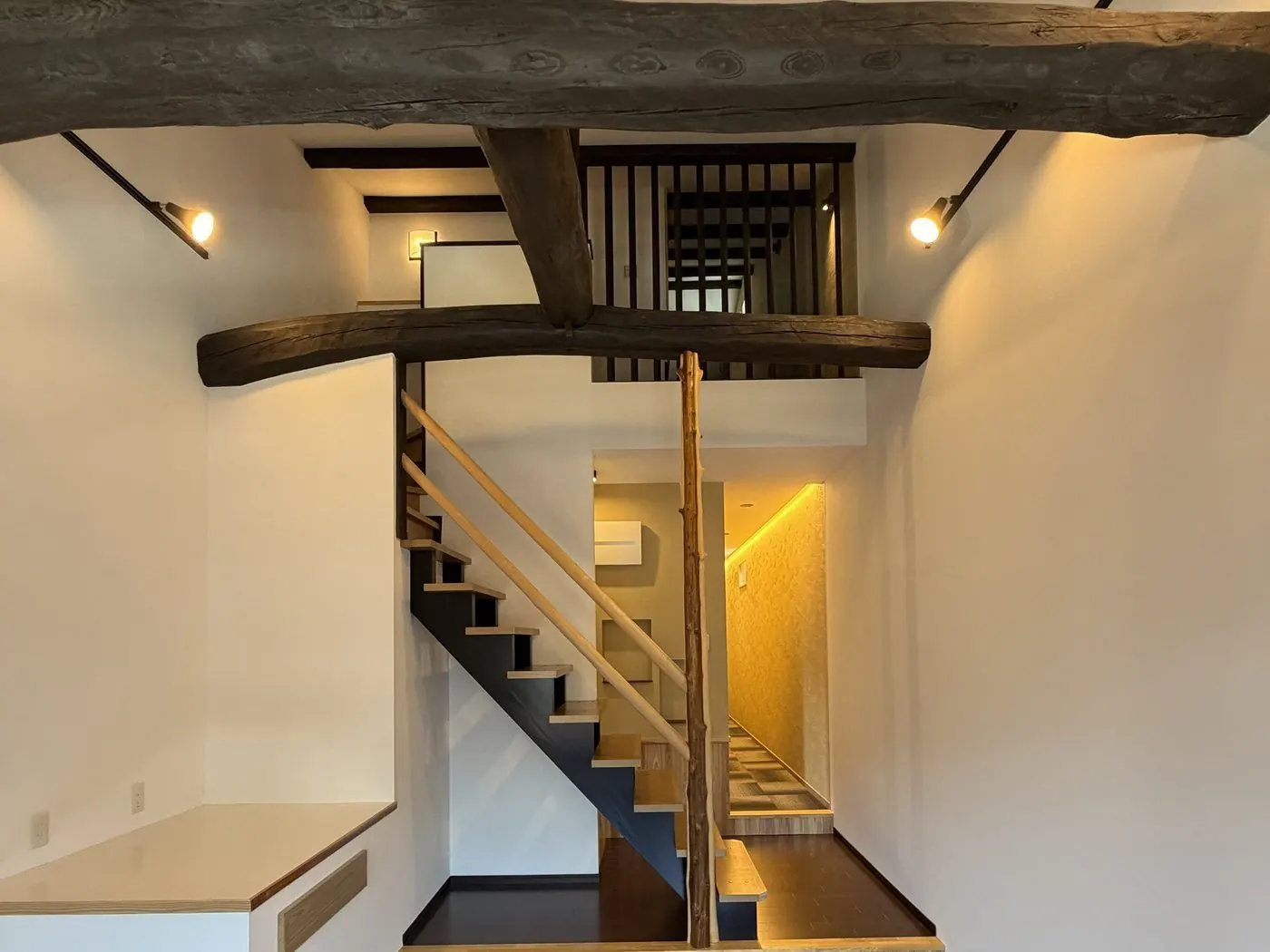
A stairwell repaired with its frame kept
One of our kominka restorations. Even a tired Japanese-style room can go to the next user if the frame of posts and beams is sound: we removed the ceiling to expose the beams as a stairwell. Four months of work, construction cost ¥9 million. → See this project in detail
We buy houses with termite damage with neither treatment nor clearing out done. We confirm where the damage is and how far it spreads, allow for the repair cost, and price the house on that basis.
Many people believe, “a house with termites can't be sold until they've been exterminated.” Selling through an agent to an ordinary buyer, that's close to the reality. The buyer is going to live there. Hear that there are mud tubes (the tunnels termites travel through) under the floor, and the deal can stall. The seller also still has a duty to disclose it. Selling to us starts from a different premise. The buyer is us — a builder who's going to repair it. At the site survey we look underfloor and at the base of the posts, work out how far the damage goes and how to fix it, and buy knowing all that. Because we buy knowing, liability for defects after handover is waived. You won't be held responsible later for “there were termites.”
That's exactly why we list leaks, a lean and termites among the conditions we buy as they are. The contents can stay as they are. We can appraise it even before the inheritance registration is complete. Handover can be as little as two weeks from the site survey. Our price is lower than a sale through an agent, because we take on the repair cost and the risk of it sitting unsold. In return, you never have to pay upfront for extermination, clearing out or demolition.
Hokuriku termites are mainly the Yamato termite. It starts from the plumbing
Termite damage starts where there is water and moves to the sill, then the foot of the posts. It climbs to the beams and central post only in a house where water went unstopped for years.
Of the termites that attack buildings, two species are widespread in Japan: the Yamato termite and the Formosan termite. According to the Japan Termite Control Association, the Yamato termite is found nationwide except northern Hokkaido, while the Formosan termite is found in the warm coastal belt from Kanagawa westwards, parts of Chiba, the Nansei Islands and the Ogasawara Islands. On that distribution, what appears inland in Toyama and Hida is, to all intents, the Yamato termite. Distributions are re-surveyed, though, so check the latest distribution and how to tell the two apart in the association's Q&A.
Two things about the Yamato termite that owners should know. One: it likes damp timber and spreads slowly into dry timber. The association explains that in buildings the damage centres on the lower timbers of damp areas such as bathrooms and kitchens. Two: unlike the Formosan termite, which builds a large nest and eats through a whole house at once, it spreads slowly near the water, from the sill up to the foot of the posts.
So termite damage advances along the path of the water. The order we have seen on site is almost always the same. Damp ground under the floor, leak water running inside the walls and pooling at the foot, a leak from the bathroom or kitchen pipes: the sill in such places is eaten first, then the damage climbs to the foot of the posts standing on it, the foot hollows out and the post sinks. This order is why the leaning house page says that a house where only the floor near the north-side plumbing sinks usually has rot in the sill and post feet. Reaching the beams and the central post takes years of unstopped water, and houses that far gone are rare.
The reason Hokuriku houses are not free of termites is water too. Between the thaw and the rainy season the underfloor has little time to dry; if roof snow shifts the tiles, rain gets in from spring; and once nobody lives there, nobody opens the windows and the damp never leaves. Conversely, in a house where the water has stopped and the underfloor is dry, damage spreads slowly. Rather than lumping everything under "a house with termites", look at where it is damp and how far they have eaten. That is the whole of the judgement on whether it can be repaired.
Signs you can find yourself. And why, if you find them, you need not call a pest controller first
Walking into the family home after a long absence, there are four signs you can spot without any special tools. If you find one, photograph it and note where. That alone makes our rough figure more accurate.
Mud tubes. Brown lines about as thick as a pencil, built from soil and droppings. They run from the ground up towards the timber on the sides of foundations and pier stones, the underside of the sill, and the foot of the bathroom walls. Termites dislike light and dryness, so they travel inside these tubes to reach the wood. A dry, crumbling tube is an old trace; a moist one with white insects inside when broken open is active
Winged termites and shed wings. According to the association's material, Yamato termite swarmers fly in daytime in April and May (in cold areas this can slip into June). A mass of wings of the same length by the windows or inside the front door means there was a nest in the house. Unlike winged black ants, they have no waist and their four wings are almost the same size. How to tell them apart is in the association's Q&A
A sinking floor. One patch is springy when you walk on it, there is a dip where furniture stood, or when you lift the tatami the floorboards are blackened and give under a finger. Common near the plumbing on the north side, in the changing room by the bath and around the kitchen back door
A hollow sound at the foot of a post. Tap lightly with the handle of a screwdriver from the floor up to about 30 cm. Sound timber gives a hard, solid sound; timber eaten inside gives a dry, light one. The surface can look fine while the inside is hollow, so check by sound. If it crumbles when pressed, that post is a candidate for splicing
Most people who find these signs ring a pest controller first. But if you are thinking of selling, treatment need not come first. Three reasons. First, treatment stops the insects with chemicals; it does not restore hollowed sill or posts. What decides things is not whether there are insects but how far they have eaten, and that is for a carpenter to see, not a pest controller. Second, if the water has not been stopped, they come back into timber that cannot dry. Third, if you sell to us, the seller paying for treatment does not change our price, because we stop the water, replace the timber and do whatever treatment is needed together as part of the repair.
If you live in the house and winged termites are appearing now, of course treat it quickly.
The line between repairable and not. Where the damage stops
If it stops at the sill and post feet, replacement and splicing repair it without dismantling. A house where it has climbed to the beams and central post depends on the extent; we look on site as far as the roof framing before judging.
We look at one thing. Does the damage stop at the sill and the foot of the posts, or has it climbed to the beams and the central post? The former can be repaired. The latter depends on the extent, and repair costs can approach rebuilding.
Only the sill is eaten ─ repairableThe commonest case. The sill is close to the ground, gets damp easily and is the first timber eaten, but the weight of the house is carried by the posts and beams; the sill is the horizontal timber that lines up the post feet. We cut out the damaged section and replace it with new timber. Only part of the floor and walls needs opening, and the house does not need dismantling.
Sill and post feet eaten ─ repairableThe foot of the post is hollow and the floor sinks. This is where splicing (netsugi) comes in. Only the rotten part of the post is cut away and new timber is joined on. Rather than replacing the whole post, it replaces only the damaged foot, a technique used in kominka repair for generations. Because we can replace damaged posts and beams without dismantling the building, we can correct the tilt and replace the post feet in one go.
Climbed to the beams, central post or roof framing ─ depends on the extentSeen in houses where a leak went unstopped for years and water ran up the posts. A single beam or post can be replaced, but once a wide area of the frame has rotted, more timber is replaced than kept and repair costs approach rebuilding. For a house in this state, we too may be unable to value it as a building. Even then the land has value, so we never refuse an appraisal.
One more thing worth knowing about old Toyama houses: posts on stones. In this traditional construction the posts simply rest on footing stones and there is no sill at all. "The termites got the sill" does not apply; instead, the foot of the post near the ground gets damp directly. Here we splice the post feet and reset the sunken footing stones. Depending on the intended use, this is also when we may cast new reinforced-concrete foundations and fix the posts to them. As the Toyama kominka restoration guide says, Hokuriku houses are framed with thick posts and beams to carry the weight of snow, and the frame is often sound even at 100 years old. Thick timber can keep its core even when the surface is eaten, so more of it can be saved by splicing.
As a guide, a house where the sinking floor is confined to one corner near the north-side plumbing is on the repairable side. A house where the upstairs floor also slopes, the ceiling has come down, or a leak has gone unstopped for years may have damage higher up, so we look on site as far as the roof framing.
Treatment alone does not finish the job. The order for stopping the water that causes the rot
Termite damage is a water problem before it is an insect problem. Termites come because there is damp timber. So we do not put treatment first. The order is this.
1. Stop the water pathFor a leak, repair the roof; for a leaking pipe, replace the pipe; for underfloor damp, clear the vents and, if needed, apply damp-proofing. Skip this and treat only, and another colony moves into timber that cannot dry. Even if all you do is put a tarpaulin over it for now, this step comes first.
2. Replace the damaged timberReplace the sill, splice the post feet and, if needed, replace a single beam. Hollowed timber does not get its strength back from chemicals. What has to be replaced is replaced. This is the step where the floor and walls are opened.
3. Anti-termite treatment and correcting the tiltThe new timber and the surrounding sill get anti-termite treatment, and the sunken posts are righted. Fit connectors while the house still leans and they no longer fit once it is righted, so the seismic connectors come after this.
4. Make it a house that driesWe secure a path for air under the floor and give the wet areas a floor that dries easily. The emptier a house, the more damp it traps, so when we buy and repair a house we keep it ventilated until the next occupant moves in.
Skip steps 1 and 2 and order treatment alone, and the usual result is that they come back a few years later. On the page on a house with a neglected leak we set out how water travels from the roof to the post heads, inside the walls and down to the foot. Think of termites as waiting at the end of that path, and the order of repair follows naturally.
What matters to the seller is that none of these four steps is something the seller has to do. For a house we buy, we repair it in this order. The seller does not need to bring in a pest controller first, or open the floor and replace timber.
Selling through an agent means disclosing. Why liability is waived when we buy
Through an agent, disclosing the termites and liability for defects stay with the seller. When we buy, the repairer looks under the floor and at the post feet and buys, so liability after handover can be waived.
When selling a house with termite damage through an agent, there is no getting round disclosure and liability for defects. A little law.
Say the type, quality or quantity of the house handed over doesn't match the contract. In that case the buyer can require the seller to fix the shortfall, by repair or otherwise (art. 562), reduce the price (art. 563), or claim damages and cancel the contract (art. 564). This is what the Civil Code sets out. The buyer must notify the seller within one year of discovering the non-conformity (art. 566). And even with a clause promising “no liability” (a clause excluding warranty liability), the seller isn't released from liability for something they knew and didn't disclose (art. 572). You can check the wording in the Civil Code on e-Gov Japanese Law Search.
Signs of termites are a textbook case of this “non-conformity in quality.” Selling through an agent to an ordinary person, if you know about mud tubes or a sagging floor, you write it into the disclosure document for the buyer. Know about it and not write it down, and you're held liable even with a “no liability” clause (Civil Code art. 572). If mud tubes turn up under the floor after the buyer has moved in, a demand for repair costs or a price reduction can land on the seller. This “liability that stays with you after handover” is the weight of selling a damaged house through an agent — more so if the seller lives outside the prefecture.
Liability for defects is waived when we buy because we, the buyer, buy knowing of the defects. At the site survey we go under the floor, tap the foot of the posts and look at the roof framing, and we contract knowing the extent of the damage and how to repair it. A buyer who bought knowingly cannot later say they did not know. The waiver is a promise built on that. That is why we ask sellers to tell us, without hiding anything, whatever they know. We ask you to tell us not so anything can be hidden, but so the waiver holds. "The winged termites appeared three years ago", "the bathroom floor was repaired once ten years ago": details like these are direct leads for our survey.
None of this rejects selling through an agent. If the frame is sound and the damage is one section of sill, you may treat, repair, disclose and sell through an agent for more than we would pay. Even then, we can give you the repair quote. The repair quote and our price come from the same company, so you can set the figures side by side and decide which leaves you with more.
Cost guide: partial repair from a few hundred thousand yen
One section of sill and one or two post feet is a partial repair from a few hundred thousand yen. A house that leans with several post feet eaten has its splicing and righting done within seismic reinforcement, with the scaffolding and opening-up done once.
The cost of repair depends on the extent of the damage and what it is combined with. Our guides, as construction costs.
Where the damage is limited to one section of sill and one or two post feet, partial repair is enough. We take spot repairs, such as a leak or one bathroom, from a few hundred thousand yen, and replacing sill, splicing and stopping the water path often fall within that range. Open the floor and walls, replace the timber, close up. The work takes a few days and can be done with you living there.
Where several post feet have been eaten and the house leans, we treat splicing and righting as part of seismic reinforcement. Our guide for seismic reinforcement (wall area, connectors, foundations) is ¥2.5–7 million. Righting the posts of a kominka on stones and resetting the footing stones, or casting new foundations, falls within this. It looks expensive, but there is a reason. To right a post you open part of the floor and walls. To fit connectors you open the same places. Lightening the roof and righting both need scaffolding. As the tilt page says, order the three separately and you erect scaffolding three times and lift the floor three times. Done together, once. Re-roofing (tiles, snow measures) at ¥2–4.5 million uses the same scaffolding.
Whether you repair to live, to let or to run as a guesthouse, our view is that termite repair should be planned together with the structural work. The figure is fixed after the free site survey, and items likely to rise, such as sill rot that only shows once the floor is opened, we flag at the rough-estimate stage.
If you sell unrepaired, the seller pays none of this. Our price is set having allowed for this repair cost. Because the repair cost and our price come from the same company and the same survey, you can compare repairing and keeping against selling unrepaired with the same yardstick.
What we look at on site. What to photograph for us
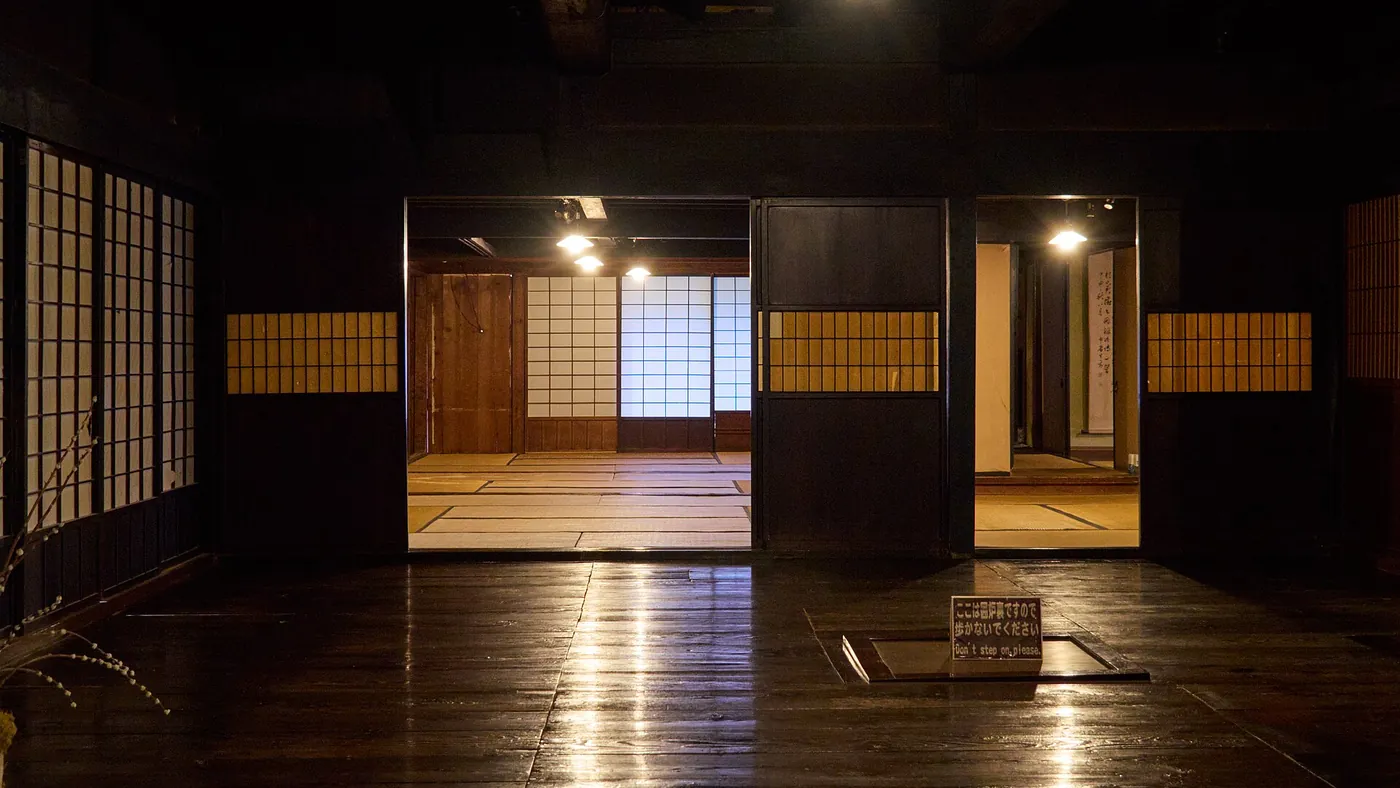
The boarded room and tatami room of a kominka (Hida Folk Village, Takayama)
It starts with photos. No clearing out or cleaning needed. As far as you can, photograph these three places and send them with the location on LINE. If you live outside the prefecture and cannot come back, we hold the key and go to look.
1. Where the floor sagsThe springy spot, one wide shot from the doorway. If you can lift a tatami mat, one of the surface of the floorboards. Frame it so a window or post shows which side of which room it is. Whether it is near the north-side plumbing gives us a first idea.
2. Where mud tubes showThe sides of foundations and pier stones, the foot of the bathroom and kitchen walls, under the step at the entrance. If there is a brown line, two shots: one from a little way back, one close up. Add whether it is dry and crumbling or moist.
3. The foot of the postsFrom the floor up to about 30 cm, post by post. It helps if you mark the posts whose surface is crumbling, that are blackened, or that sounded light when tapped. The same for posts visible at the foot of the outer walls.
Send photos and we send back a rough range. Then we visit for the site survey, and look in this order. Into the underfloor to check the sill for rot and mud tubes, and the posts for shifting off their stones. The foot of each post, tapped one by one to gauge how much splicing can cover. Up into the roof framing to see whether water has got into the beams and post heads. It takes about an hour, and these three places all but decide the value of the frame. The survey is free, and there is no charge if you decline.
After the survey, if the house can be repaired we give you both the repair cost and our price. If it cannot, we tell you honestly. If we buy, the contents can stay, the inheritance registration is completed before handover (we introduce a partner judicial scrivener), and handover is in as little as two weeks from the site survey.
FAQ
Can you appraise right after winged termites have appeared?+−
Yes. Swarming winged termites mean there is a nest in the house, but that alone does not tell us the extent of the damage. Our appraisal checks the underfloor and the foot of the posts to see where the damage stops; whether insects are active is not what decides the price. There is no need to treat before contacting us, and a photo of where the wings fell is a useful lead for the survey.
There is no treatment record and I don't know how long the termites have been there. Can it be sold?+−
Yes. When we buy, a treatment history or a warranty is not a condition. We confirm the extent of the damage at the site survey and buy knowingly, so liability for defects after handover is waived. Tell us what you do know (the year you saw winged termites, when the floor started to sink, any record of repairing the bathroom, and so on) and the survey is more accurate.
The floor has given way and the post feet are crumbling. Is demolition the only option?+−
If the damage stops at the sill and the foot of the posts, it can be repaired without demolition. Damaged sections of sill are replaced, and posts are repaired by splicing: cutting away only the rotten foot and joining new timber. Hokuriku houses are usually framed with thick posts, and a post can be kept if its core is sound even though the surface has been eaten. If a wide area up to the beams and the central post has rotted, repair costs approach rebuilding, so we look on site as far as the roof framing before judging.
Will I get a better price if I treat the termites before selling?+−
If you sell through an agent to an ordinary buyer, treating, repairing and then disclosing makes things go more smoothly. But treatment only stops the insects; hollowed sill and posts do not recover, so repair is needed separately. When we buy, the seller paying for treatment does not change our price, because we stop the water, replace the timber and apply anti-termite treatment as part of our repair. If you are thinking of selling, we suggest this order: send photos before treating, and find out whether the house can be repaired and what it is worth.
If the termites spread to the house next door, am I liable?+−
In general, termites move through the soil, and proving that a neighbour's damage came from your house is considered difficult, so legal liability rarely arises. That said, a vacant house whose neglect causes trouble to the neighbours can fall under the poorly managed vacant house rules of the Vacant Houses Special Measures Act. If the neighbours are complaining, deciding quickly what to do with the house is calmer than arguing over liability. For your individual case, consult a lawyer.
The floor sinks and the whole house feels as if it is leaning. Is that termites?+−
A house where only the floor in one corner near the north-side plumbing sinks usually has rot or termites in the sill and post feet. If the whole house leans in one direction, the cause may be the ground or the footing stones. The four causes of a tilt and how each is fixed are covered separately in Can a leaning house or kominka be repaired?. Houses with overlapping causes are not unusual, so we check under the floor.
If I sell without repairing, how much lower is your price?+−
It depends on the extent of the damage, so we cannot give a set percentage. Our price is the land value plus the value of the building, less the repair cost and the risk of not selling. For a house where one section of sill and a few post feet are affected, the repair we deduct usually stays within a few hundred thousand yen, and the building keeps almost all its value. Unlike a demolition-based appraisal, we deduct neither demolition nor disposal of the contents. Send photos and the location and we send back a rough range.
This page is a general explanation. For termite species and habits it draws on the published material of the Japan Termite Control Association, and for liability for defects on the Civil Code (e-Gov). Whether a house can be repaired, and for how much, cannot be settled without looking under the floor and at the foot of the posts. All figures are guide construction costs as of September 2026.
Before you treat, send photos.
The sinking floor, the post feet, the mud tubes. Photos of what you can see, plus the location, are enough. Contents in place, before registration, from anywhere. Appraisal is free, and there is no charge if you decline.
By phone (Japanese only)9:00 - 17:00After 17:00, site manager (Japanese only)
Other damaged-house questions.
Tilting, leaks, seismic reinforcement. The damage that comes with termites, how it is repaired, and the route of selling unrepaired, each on its own page.