Minpaku filing (Private Lodging Business Act) — for owners about to turn a house into a guesthouse / Toyama

In Toyama, the filing to start a minpaku is split between the owner and the management operator

The filing is in the owner's name; the management is in the registered operator's name. Who does what, in which order, on one table. Built around a guesthouse whose filing we saw through in Toyama.
1 "I want to turn the family home into a guesthouse" is enough to startFree consultation on LINE 2 9:00–17:00, Japanese only / after 17:00: Call us

The filing and the management are in different names

Starting a minpaku in Toyama begins with filing under the Private Lodging Business Act with Toyama Prefecture. The owner of the house is the one who files, and once the filing passes, the prefecture issues a sign bearing the filing number. This name stays the owner's after opening too.

There's another category to know. Some minpaku have the owner absent from the house while guests are staying (a host-absent minpaku). In that case, the rule is that all of the management work must go to a management company registered with the Minister of Land, Infrastructure, Transport and Tourism (a registered private-lodging management operator). Farming out just the cleaning, or just the keys, to separate contractors doesn't satisfy this rule. We're registered as a private-lodging management operator (Minister of Land, Infrastructure, Transport and Tourism (01) No. F06163). For a host-resident minpaku, where the owner lives in the same house and is there during the stay, this outsourcing isn't required.

The filing is the owner's; the management is the registered operator's. Once you see that these are two separate names, the steps fall into place. The table below separates what the owner does from what the management operator does, in order. After the filing passes, we take on the management as the minpaku management company in Toyama.

Who does what, in what order: the division of work

Left to right. Top row: what the owner does. Bottom row: what the management operator (us) does 1 Feasibility 2 Fire safety 3 Filing 4 Sign 5 Entrusting 6 Operation 7 Reporting File it online in the minpaku portal system Form, pledge, safety-measure checklist Display the prefecture sign Host absent? Entrust all to one registered operator Operate up to 180 days a year Owner Site check: use, fire code, room count (before work) Exit signs, smoke alarms, extinguishers; fire-compliance certificate Prepare papers, accompany you We take it on (registered) Bookings Cleaning Keys Neighbours Guest register Reporting by the 15th of even months Manager (us) Our registration as a private-lodging management operator: Registration No. 国土交通大臣(01)第F06163号
The steps from filing to operation, split into what the owner does and what the management operator (us) does. No durations or costs are shown.
StepThe ownerThe management operator (us)
Feasibility—See the use, fire safety and number of rooms on site. Find out whether the filing will pass before any construction
Fire safety—Install exit signs, smoke detectors and fire extinguishers, and obtain the fire-code compliance certificate
FilingFile online through the minpaku system (on paper only when unavoidable). Filing form, written pledge, safety-measures checklistPrepare the documents and accompany the owner
SignDisplay the sign issued by the prefecture—
EntrustingFor a host-absent minpaku, entrust all management work to one registered operatorWe take it on (国土交通大臣(01)第F06163号)
OperationUp to 180 days a yearBookings, cleaning, keys, neighbours, guest register
Reporting—Periodic reports by the 15th of every even month

Work from the top of the table down. Fire equipment comes before the filing because the filing needs the fire-code compliance certificate. "Will the filing pass" comes before the filing so that no construction is done on a house that would not pass. The filing itself, as Toyama Prefecture's page states, is done online through the Japan Tourism Agency's minpaku system as a rule; filing on paper is limited to cases where that is unavoidable.

Steps marked "—" in the owner's column are steps we handle in the owner's place. For the items in the owner's column, we prepare the documents and accompany you. What the owner must do personally is file as the named filer and display the sign once issued.

The order we actually followed at the guesthouse we filed

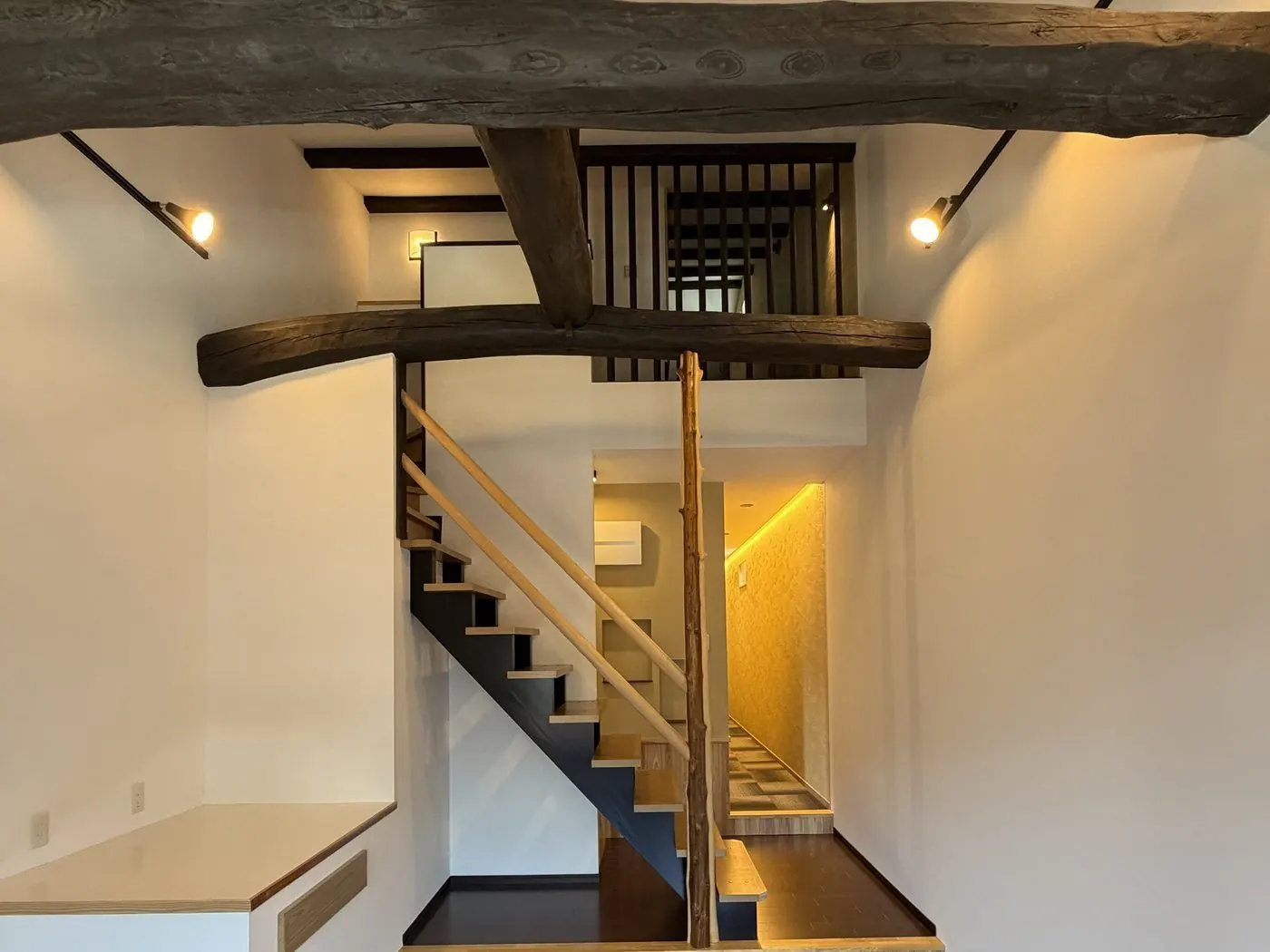
Kominka opened as a minpaku guesthouse: the stairwell with exposed beams (after)

We turned an old house in Toyama Prefecture into a guesthouse. The first thing we did was not construction but finding out whether the filing would pass. On the assumption of opening under a Private Lodging Business Act filing, we checked the use, fire safety and number of rooms on site before starting on the construction plan.

As the fire equipment required for the filing, we installed exit signs, smoke detectors and fire extinguishers. We then filed under the Private Lodging Business Act, and the guesthouse opened under filing number M160066697. It can operate up to 180 days a year.

We also manage this guesthouse now that it is open. The filing stays in the owner's name, and we handle bookings, cleaning, keys, the neighbours and the reports to the prefecture. The construction and photos are in Case 01; the whole process from construction to guesthouse is in Turn a kominka into a guesthouse: Yadosu.

After the filing passes: what the management operator does

Once the filing has passed, the sign is up and the management has been entrusted, the day-to-day work moves to the management operator: listing and replying on booking sites, cleaning, key handover, explaining to the neighbours and taking complaints, the guest register. Before opening, we go and explain to the neighbours ourselves. Toyama Prefecture's page also lists informing the neighbours among the steps to complete before filing.

Periodic reports to the prefecture are due by the 15th of every even month. Nights occupied and guest numbers are reported through the minpaku system as a rule. We file these reports too.

The full scope of what we take on, how the fee works and what winter brings are set out in What we take on as your minpaku operator. This page covers only who does what for the filing.

Restrictions and forms: check the prefecture's page

Whether there are restrictions on area or period is not something this page states. For the explanation of the system, the filing forms and the list of filed houses, check Toyama Prefecture's page on the private lodging business (Japanese). The preconditions for filing and the rules on entrusting management are on the Japan Tourism Agency's minpaku system portal.

Our registration number (国土交通大臣(01)第F06163号) can be checked against the register of private-lodging management operators kept by the Hokuriku Regional Development Bureau. Before you choose who manages your minpaku, check the number.

FAQ

What if I want to operate more than 180 days a year?+−

Under the Private Lodging Business Act filing you can operate up to 180 days a year. To go beyond that you need a hotel business licence (Ryokan Business Act), which changes the building requirements and the construction. The difference between the two systems, and how to decide which to use, is on the page Turn a kominka into a minpaku.

I filed myself. Can I ask you for the management only?+−

Yes. The filing stays in the owner's name and you entrust the management work to us. When the management operator changes, the filed details have to be amended, and we handle that together with you. What we cover and how the fee works is on the page Minpaku management and operation in Toyama.

I live outside Toyama. Do I need to come to Toyama to file?+−

Filing is done online through the minpaku system as a rule, and we prepare the documents and check the site. Contracts, meetings and handing over keys for owners living outside the prefecture are covered in the FAQ on Minpaku management and operation in Toyama.

Will the July 2026 "zero-day rule" ban minpaku in Toyama?+−

Not across the whole country. On 15 July 2026 the Japan Tourism Agency and other ministries issued advice to local governments on the zero-day rule (an ordinance setting the number of days a minpaku may operate to zero). How far operation is actually restricted is decided by the ordinance of the prefecture or city where the property is. Check the ordinance at the prefectural or city office before you notify.

Start with just the location and photos of the house.

We first check on site whether the filing will pass. After the filing passes, we take on the management as minpaku management and operation in Toyama.

Ask on LINE Ask by form
By phone (Japanese only) 9:00 - 17:00 After 17:00, site manager (Japanese only)

Also read

What we cover and the fee, the steps from construction to guesthouse, and the difference between the two systems.

Minpaku operation and management in Toyama → Turn a kominka into a guesthouse: Yadosu → Minpaku rules and a real example → Case 01: opened as a minpaku →

Written by Kota Makimura, Hokuriku Homes Updated

Phone9:00–17:00 LINEChat Free adviceQuote after a site visit
LINEChat