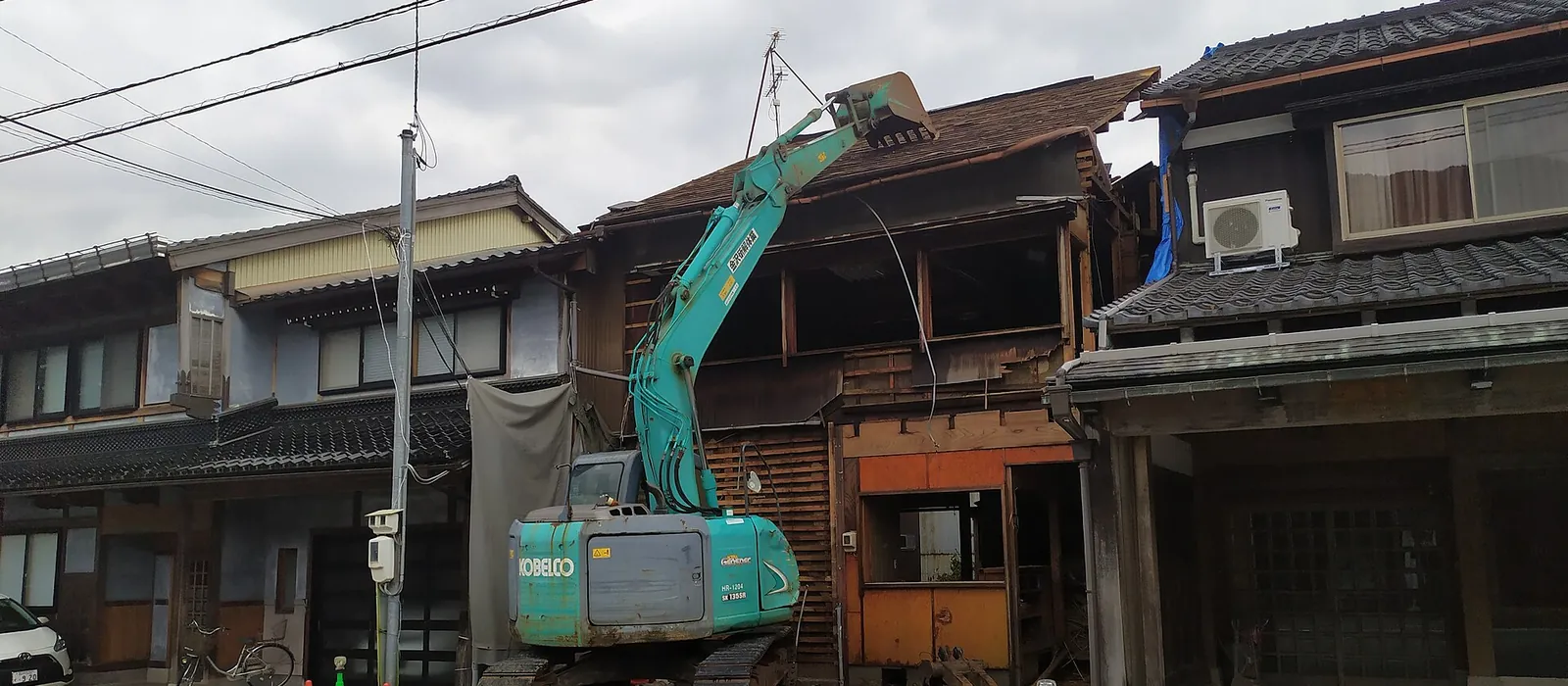
What demolition costs in Toyama, how your property tax rises the moment you demolish, and how to let the house go without paying for demolition — in order.
Demolishing a wooden house in Toyama costs about ¥30,000–50,000 per tsubo (3.3 ㎡).
A 130 ㎡ house starts at about ¥1.5–2 million, and a 200 ㎡ farmhouse at about ¥2.5–4 million.
If you demolish and clear the land, the land's property tax rises several times from the next year.
Before demolishing, get one as-is purchase appraisal.
The appraisal is free, and there is no charge if you decline.
Before deciding "it won't sell, so demolish first", know what it costs and what happens once it is gone. Toyama houses are big, and demolition costs more than people expect. And in most cases, selling without demolishing leaves you more.
Demolishing a wooden house (main work)about ¥30,000–50,000 per tsubo (3.3 ㎡)
130 ㎡ houseabout ¥1.5–2 million and up
200 ㎡ farmhouse / azumadachiabout ¥2.5–4 million and up
Outbuildings: storehouse, barn, garagefrom a few hundred thousand yen each
Felling and stump removal of a windbreak grove (the scattered-village areas of Tonami, Nyuzen, etc.)varies widely with the number and size of trees
The size of the house is not the only thing that pushes the bill up.
A narrow road that machinery can't get down
Neighbours close by, so more work by hand
Removing a septic tank or well
The asbestos survey
Before demolishing a house, an asbestos survey is required for practically any job. Since April 2022, jobs above a certain size have had to report the survey results. Since October 2023, only a qualified person may carry out the survey. For a Toyama farmhouse, once you add the kura storehouse, barn and windbreak grove to the main house, the total often exceeds ¥3 million. How to hand over a farmhouse with rice fields or forest attached without demolishing it is set out in Selling a family home with rice fields or forest. When only the storehouse or barn is starting to collapse, how to choose between demolishing it, keeping it, or selling the whole property with the main house is set out in A collapsing kura or barn.
Demolish, and the property tax goes up
Demolition means paying money to raise your tax every year.
Land with a house on it gets the residential land relief, cutting the property tax base to as little as one-sixth. Demolish and the relief ends the next year, multiplying the tax on the land. Demolishing with no buyer in sight is the most expensive order of all. How land value minus demolition and clearing comes to "zero" or "minus", and how a no-demolition appraisal differs: Demolition-based versus no-demolition appraisals. Leave the house and get an order as a hazardous or poorly managed vacant house, though, and the relief goes too — so the answer is "don't demolish, don't neglect, move early".
The scheme for handing inherited land to the state cannot be used while a building stands, so this demolition cost comes first — see Renouncing, state takeover, or selling. And without demolishing, an order from the city removes the same relief; how to read a notice is in A notice from the city.
One thing to do, without fail, before demolishing
Get an as-is appraisal. It is free, with no charge if you decline
Demolish and you lose the "buyer demolishes" route to the ¥30 million deduction. Appraisal comes first
Most municipal demolition subsidies must be applied for before work starts. Afterwards is too late
Storehouses, fittings and old timber can be worth something. Demolished, zero; kept, they count
We are a buyer who does not assume demolition. We repair the houses we buy and pass them on. So we do not need to price in a demolition cost — that money stays in your pocket. It is not too late to decide on demolition after seeing our offer. Even a house with a collapsed roof: we first check whether the main house's frame can be repaired. → How to tell a damaged house that can be sold without demolishing
If you are torn between demolishing and keeping, first check which way suits your house on the eight-question check page. No sign-up needed.
FAQ
Can you give an exact demolition quote?+−
Our free appraisal gives the price for selling as it is. For comparison we can also give a rough demolition figure, so you can weigh the three options on one table: demolish then sell, sell as is, or demolish and keep the land.
Is it better to demolish with the city subsidy and then sell, or to sell as it is?+−
It depends on the property. Subsidy conditions and budget limits vary by municipality and fiscal year. Most require you to apply before work starts and finish it within that fiscal year. Even with a subsidy, some cost is left for you to pay, and once the lot is cleared, property tax goes up. The reliable way to decide is to set it beside our offer to buy the house as it is.
Will you buy a house that looks close to collapse?+−
It depends on the condition, but we have bought houses with leaks, tilting and termites. Many can be restored if the frame is sound. Send photos and we give a rough view before visiting.
Do I need to demolish the house before selling?+−
No, you do not need to demolish before selling. Our purchases do not assume demolition, so we do not deduct demolition costs from our price. Demolishing raises the property tax on the land from the following year, so get an as-is purchase appraisal first and decide about demolition afterwards.
Why does demolishing a Toyama farmhouse tend to cost so much?+−
The house itself is large, and on top of that come outbuildings such as storehouses, barns and garages, plus felling the yashikirin (the windbreak woods around the house). Costs also rise when the road in front is too narrow for heavy machinery, or when neighbours are close and more of the work must be done by hand.
This page is a general explanation. Whether a tax rule applies, and the amounts, depend on your situation; confirm with the tax office or a tax adviser. The rules are as of August 2026.
Honest numbers
Before deciding whether to sell, just know the price.
Appraisal is free, with no charge if you decline. The contents can stay.