Before you sell / a collapsed roof or a house about to fall
A house with a fallen roof, a house about to collapse. Three things to check in the frame before deciding "demolition is the only way"
If the roof framing and through-posts are sound, a house can be repaired even after the roof has fallen. If not, we can still buy it as it stands. We start with what to do this week.
This week: do not go inside, look from outside, photograph before clearing anything
When only the lean-to has fallen, the main house's frame is often untouched
Selling as it stands is the only route where you are paid. As little as two weeks
Real estate + constructionA builder with both a real estate licence and a construction permit
Appraisal and survey: ¥0No charge if you decline
Toyama, Ishikawa and HidaOwners living elsewhere welcome
What to do this week: stay out of the house, and take photos before clearing
The first thing to do with a house whose roof has fallen is not to clear up, nor to get a demolition quote. It is three things: do not go in, look from outside, and take photos.
When part of a roof has fallen, you cannot tell from outside what is holding up the rest. One beam gone can mean double the load on the next one. Going in yourself to carry things out is the one thing we most want you to avoid.
1. Do not go inside. Keep people away from the housePut a notice on the front door and, if you can, a rope or cones on the road side. Tell the neighbourhood association head and the neighbours not to go near until a contractor has looked at it. If that is hard to do from outside the prefecture, we can do it on site for you.
2. Check the sides facing the road and the neighbours firstHas fallen roofing or snow reached the road or the neighbouring lot? Is it touching power or telephone lines? This part is urgent. If it has, that part alone needs removing first. What fell towards the hillside or within your own lot can wait.
3. Take photos before clearing anythingAs we also wrote on the flood recovery page, recovery has an order, and photos come before clearing. The whole roof from all four sides, directly under the fallen part, and any traces of snow or water inside, kept in a form that shows the date. The same photos serve the insurance claim, the disaster certificate application and our appraisal.
4. Contact your fire insurerIf fire insurance has been kept up on the vacant house, some policies cover snow damage. Whether yours does depends on the policy, so check the certificate and contact the insurer. The sooner the better: once things are cleared, proving the damage gets hard.
5. Contact the vacant-house desk at the city or town officeIf the road or a neighbour's land is at risk, things go more smoothly if you get in touch first. Wait for a notice and you become the party being told to act. The same desk can tell you whether a disaster certificate is issued for snow damage.
The three patterns of a fallen roof. If the main frame is sound, many houses can be repaired
"The roof has fallen" splits into three. In 1 and 2 the main frame is sound and the house can often be repaired; what tells them apart is the beam directly under the fallen part and the through-posts. Even 3 is bought as it stands.
"The roof has fallen" covers several things, but the houses we have seen on site fall into roughly three patterns. Which pattern it is decides whether it can be repaired and the order of magnitude of the cost. It is also the first thing we ask on the phone or LINE.
1. Only the lean-to or an extension fellThis is the most common. A Toyama farmhouse has a low roof called a geya, or lean-to, running round the main house, with the kitchen, bath, veranda and storage added under it. Snow sliding off the main roof piles onto this low roof, so the lean-to gives way first. The main frame is usually untouched, and if the fallen part is removed and the main house protected, the house can be repaired. Most calls saying "the eaves have fallen" were this pattern.
2. The main roof frame sagged or partly gave wayThe roof frame (koyagumi) is the assembly of beams, struts and rafters that carries the roof. Years of roof snow have bent the beams, broken rafters and let part of the roof sink inwards. What we look at here is the through-posts and central post standing beneath it. If the posts are straight, there is a fair chance of repair by replacing the damaged frame members and re-roofing. If the posts have tilted too, it is closer to the next pattern.
3. Posts broken, structure collapsedPosts broken, come off the sill, the whole house leaning hard one way: the main frame itself is broken. Here the cost of repair approaches that of a new build, so we do not recommend repairing either. But we will still buy it as it stands. The seller does not need to demolish first; we demolish after we take over.
The difference between patterns 1 and 2 is not how dramatic it looks from outside. A house whose lean-to has come down wholesale and looks unliveable may have an untouched main frame. Conversely, a house with only a few tiles out of line has turned out to have a broken beam in the roof space. The call is made on the beam directly under the fallen part and the through-posts. The stages of damage and how they affect the price are in Damaged houses: can it be fixed?.
How snow breaks a Toyama house. It breaks in winter; you notice in spring
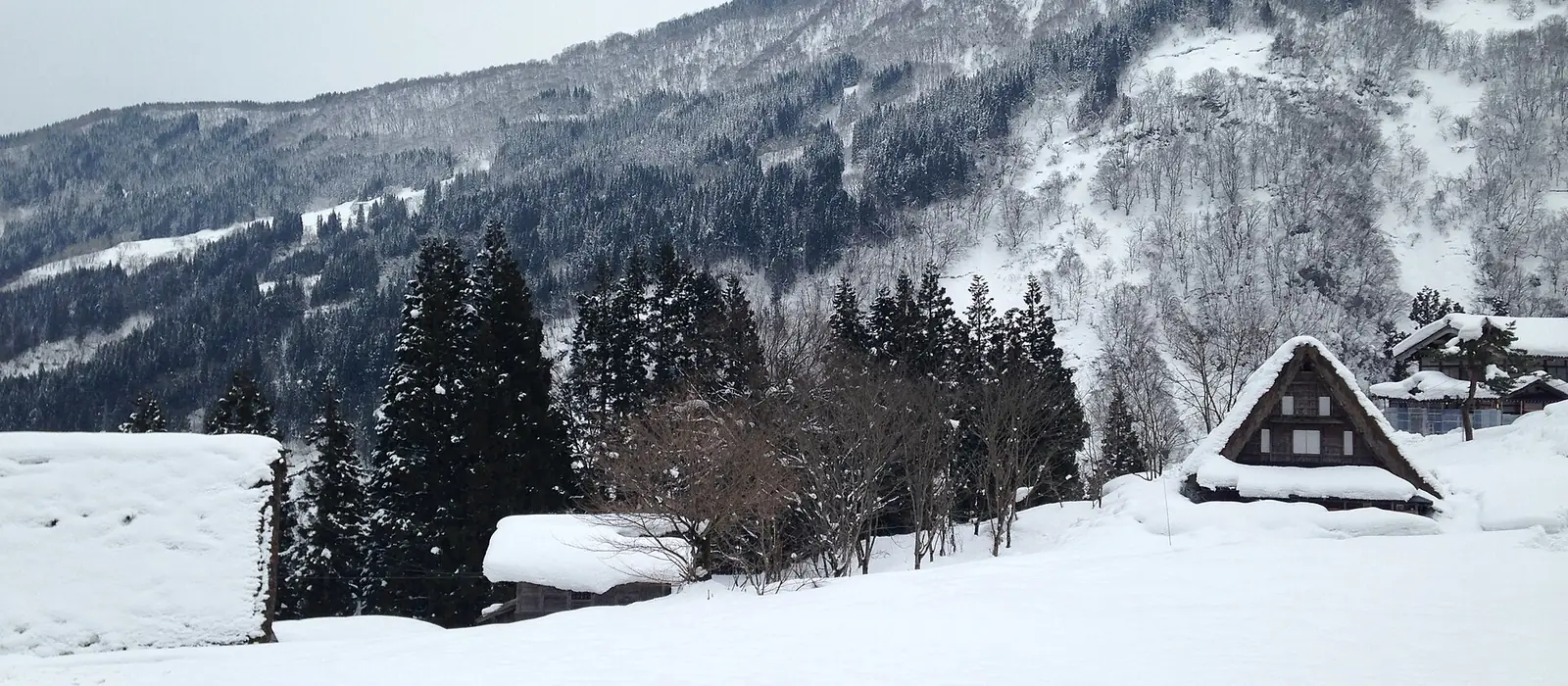
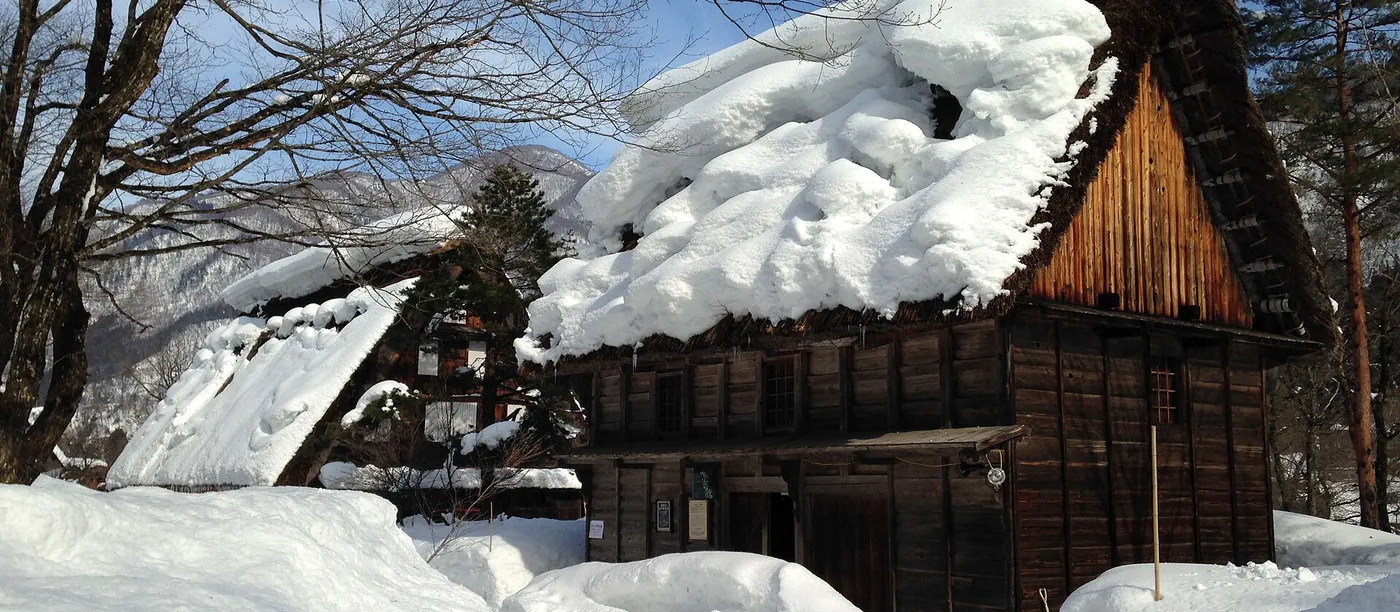
Roof snow jutting out past the eaves (Gassho-zukuri Minkaen, Shirakawa-go)
As we wrote in A year-round calendar for managing a Toyama vacant house from afar, spring is when we get the calls: water was spraying, the eaves had fallen. It breaks in winter; you notice in spring. Why does only the vacant house break? What is different from a house that is lived in? There are four reasons.
Lopsided roof snowSnow does not settle evenly on a roof. It drifts on the leeward side, in the valleys and below the steps left by extensions, so the weight sits on one side. On the tilting house page we listed roof snow load as one of the four reasons a house tilts. A tile roof laid on clay weighs several tonnes on its own; add lopsided snow every year and over the decades the posts tilt and the beams sag. Almost every house whose roof falls was already distorted in the years before it fell.
Snow cornices at the eavesRoof snow creeps out past the eaves and hardens there. That is a snow cornice. The overhang has nothing under it, so all its weight lands on the tips of the rafters at the eaves. It is why eaves droop or the eaves alone snap. In a lived-in house someone knocks the cornice down; in an empty one it keeps growing until spring.
Snow sliding onto the lean-toOn a mild day the snow slides off the main roof all at once and lands on the lean-to. A whole roof-face of snow ends up on one part of the lean-to. The lean-to is built of thinner timber than the main house, so it gives way first.
An empty house's roof does not meltIn a lived-in house, heating warms the roof from inside, the snow loosens and slides off bit by bit. In an empty house the roof is stone cold, so the snow never slides, keeps piling up, and the bottom layer turns to ice. This is one reason the neighbours' house is fine and only the vacant one collapses.
In Ishikawa, earthquake damage is added on top. A house left partly damaged by the 2024 earthquake takes meltwater through the gaps in shifted tiles and carries the roof snow on cracked walls. As we wrote in Buying in Ishikawa, we look at earthquake-damaged houses as they stand too, and judge as a builder whether they can be repaired and kept.
There is one saving grace in this kind of damage: snow breaks a house from the top down. First the lean-to and eaves, then the roof frame, and only last the posts. Unlike an earthquake or a flood, the sill and the feet of the posts usually survive to the end. That is why, judged by the frame, many houses with a fallen roof can still be repaired.
Repairable or not: the three places we look
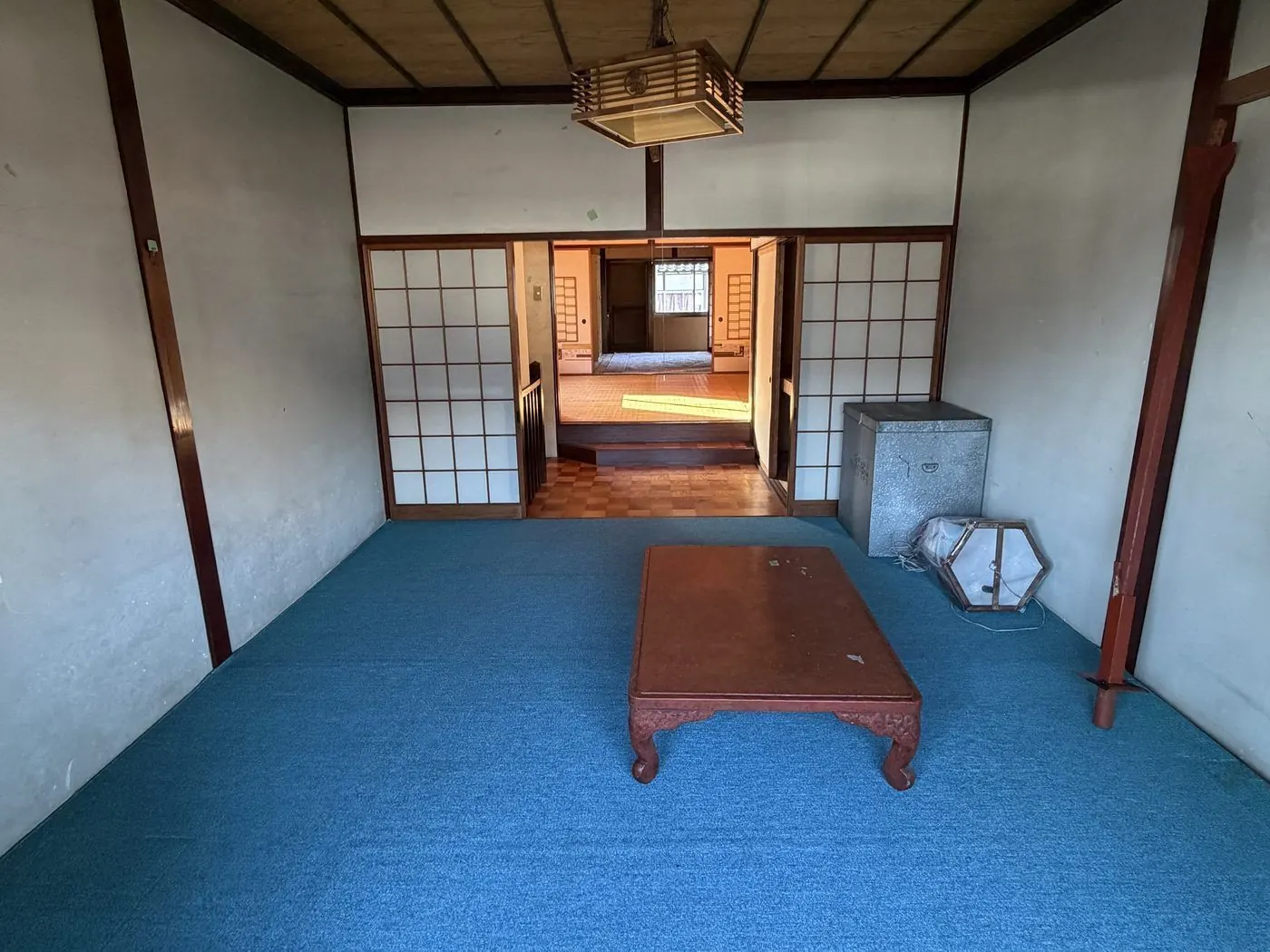
Tatami room before renovation (our project)
→
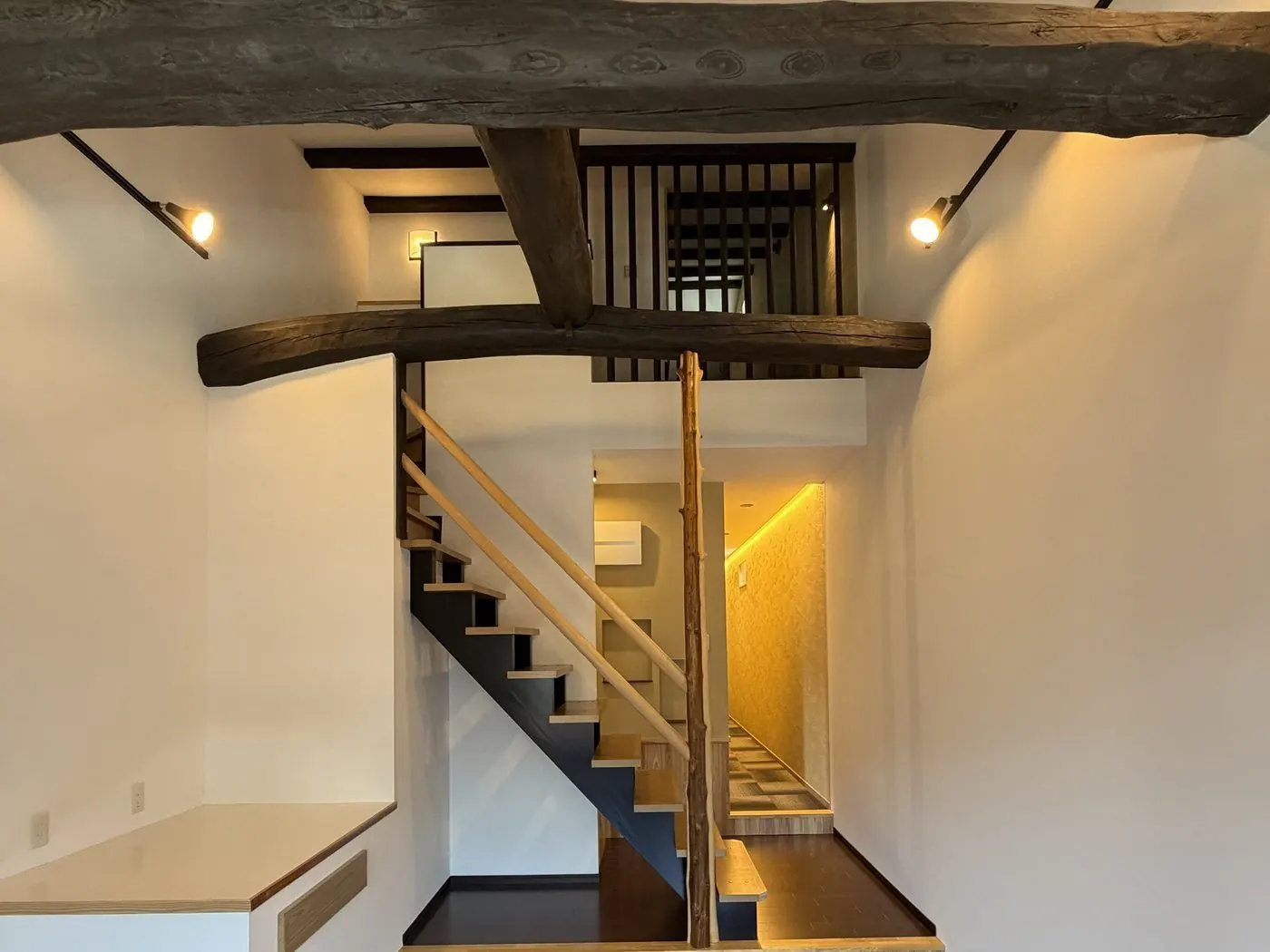
Beams exposed, ready for the next owner
One of our kominka renovations. Take out the ceiling and beams like these appear. In a house with a fallen roof, what we look at is whether these beams and posts are still sound. Four months, ¥9 million in construction cost. → More on this project
What decides whether a house can be repaired is not how much roofing has fallen. It is three places: the main members of the roof frame, the through-posts and central post, and the sill and foundation stones. If these three are sound, the roof can go back on.
1. Main roof-frame members: broken or rotten?The thick beams that carry the roof (roof beams) and the struts that hold them. Thin rafters and roof boards are consumables; if broken, they are replaced. What matters is whether the thick timber is broken or rotted by rainwater. If it is only bent, neither broken nor rotten, it can spring back once the load is taken off. We tap the beam directly under the fallen part with a mallet and listen.
2. Through-posts and central post: still standing straight?The through-posts that run in one piece from the ground floor to the first floor, and the central post at the heart of the house. If these are not broken and lean only slightly, the roof frame can be rebuilt. Even tilted posts can sometimes be pulled back upright if the only cause was roof snow, the work described on the tilting house page. If several posts are broken, it is pattern 3.
3. Sill and foundation stones: have the feet sunk?The feet of a snow-damaged house are usually the part that survives. But if the roof has had a hole in it for years, the rain that got in will have rotted the feet of the posts and the sill. In a house built on stones we also check that the posts have not slipped off their foundation stones. Rot at the foot alone can be repaired by cutting it out and splicing in new timber.
We are honest about how much photos can tell. With two of them, the whole roof from all four sides and the space directly under the fallen part, we can guess whether it is pattern 1, 2 or 3, because whether only the lean-to has fallen, whether the main roof surface is rippling, and whether the posts look tilted all show in a photo. What does not show is whether the beams are rotten or the underfloor is wet. That takes tapping and looking on site. The guess from the photos can change in either direction at the on-site survey.
For a roof brought down by snow, spring photos taken after the thaw are useful. But there is no need to wait for spring. Send photos during winter and we read the danger spots from how the snow is lying and tell you whether emergency work is needed.
The middle road: emergency measures and partial demolition
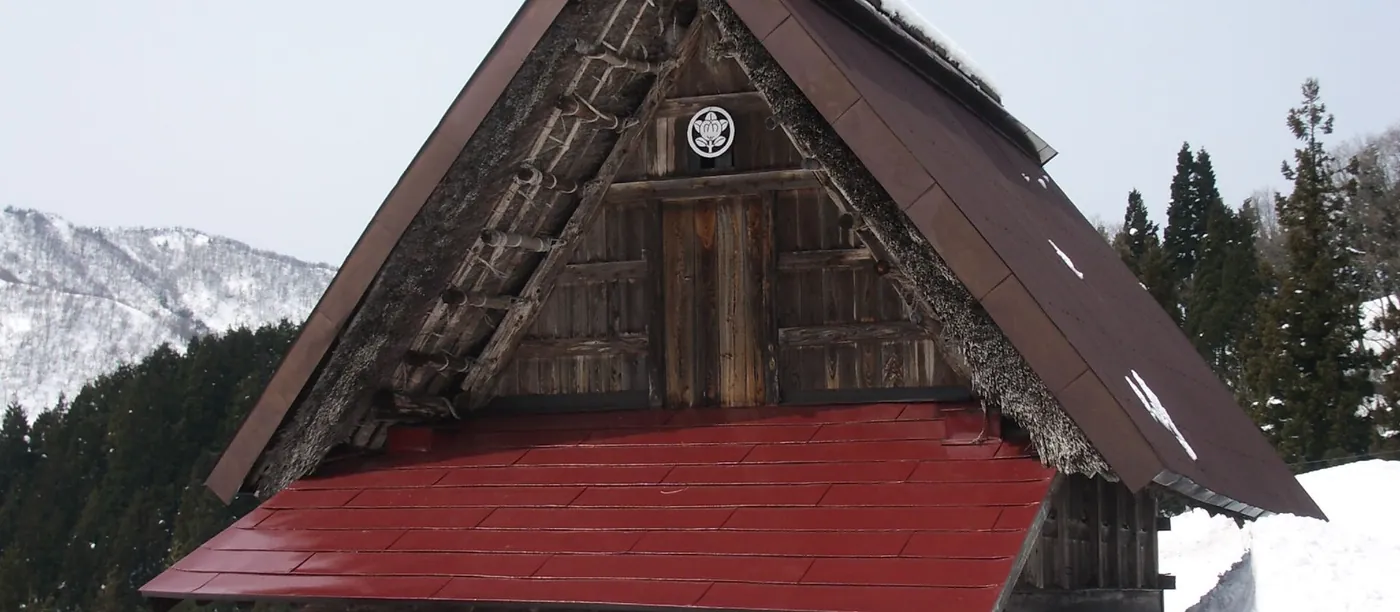
A thatched shed covered in corrugated iron, with a lean-to (Toga, Nanto)
Before choosing between repairing and demolishing, there is one more road: the middle road of removing only the fallen part and protecting the main house. For a pattern 1 house this is what we consider first, and as a builder with a construction permit we do the work ourselves.
Why "remove"? A collapsed lean-to is leaning against the main house's wall. Leave it through another winter and the snow sitting on it pushes sideways on the main house's wall and posts, and now the main house suffers. We take the collapsed part away, close up the main house's outer wall and stop rainwater getting round. It is not a full repair; it is work to stop further damage.
A word here about the blue tarpaulin, which is the first thing most people think of. A tarpaulin works against rain, but not against snow. Three reasons. First, a sheet cannot bear weight: stretched over a hole, it sinks into the hole with the snow on it. Second, snow on a sheet neither slides nor melts; it sticks, turns to ice and gets heavier. Third, wind. Hokuriku's winter wind peels the sheet off, sandbags and all, and the loose sheet lands on power lines or the neighbour's house. As a stopgap against summer leaks it is fine, but to get through winter you need to remove the fallen part or close the hole in the roof with boards and roofing felt.
The emergency work we do is along these lines: removing a fallen lean-to or eaves and protecting the exposed wall of the main house; temporary props under broken roof-frame members; boarding and waterproofing holes in the roof; removing roofing and snow that has fallen onto the road or a neighbour's land. The snow guards and changes to where snow slides off, described on the Roofs and snow page, belong to the main work, not the emergency work.
You can ask us for emergency measures even before deciding whether to sell. But if you've already decided to sell to us, you don't need to do the emergency measures or partial demolition first. We buy the house as it is, and carry out any work after we take it on. Paying for emergency measures beforehand doesn't necessarily add that amount to our offer. Send us photos first, and we'll tell you upfront which applies: “no emergency measures needed if you're selling” or “needed if you're keeping it.”
Repair, sell as it stands, or demolish. The three costs on one scale
Three options on one scale. Only road 2 brings money in; roads 1 and 3 cost money. If you are letting go, checking road 2 before demolishing is the order that loses least.
A house with a fallen roof has three exits: repair and keep it, sell it as it stands, or demolish and clear the lot. We line the three up on the same scale. The scale has three marks: money going out, time it takes, and what responsibility remains afterwards.
1. Repair and keepThis road is open to pattern 1 and 2 houses. As a guide from our own projects: re-roofing (tiles, snow measures) ¥2–4.5 million, seismic reinforcement ¥2.5–7 million. As we wrote on the tilting house page, the order of repair is tilt, structure, roof, insulation, then plumbing; tilt, structure and roof share the same scaffolding and interior strip-out, so doing them together keeps the total down. Including design it takes six months to a year. The repaired house stays yours, to live in or to rent out. Figures are a guide to construction cost and vary from house to house.
2. Sell as it standsA direct purchase with us as the buyer. No emergency work, demolition or clearing; we take the house with the contents inside and in its collapsed state. No brokerage fee, and appraisal and on-site survey are ¥0. Handover as soon as two weeks after the survey, with no liability for defects afterwards. The price is lower than a brokered sale would fetch, because we take on the repair cost and the risk of it not selling. But since we do not assume demolition, for a repairable house we do not deduct demolition cost from the price.
3. Demolish and clear the lotThis is the road for a pattern 3 house when you want to keep the land yourself. As set out in Demolition costs, a wooden house in Toyama runs ¥30,000–50,000 per tsubo (3.3 m²), so from about ¥1.5–2 million for 40 tsubo (about 132 m²) of floor area. With a kura, barn and windbreak grove included, the total often passes ¥3 million. Once the lot is cleared, the residential-land relief on property tax ends the following year and the tax on the land rises. Until the cleared lot sells, you keep holding it.
To repair and live in it, route 1. To let it go, check route 2 before demolishing. As the purchase page says, you need not decide first whether to keep or demolish. If the house cannot be repaired we say so honestly, and go as far as introducing a demolition contractor.
Counting back to winter. What happens if you contact us in November
Send photos in early November and handover, as soon as two weeks after the survey, fits in before serious snow reaches the plains. From December, we do emergency work on the road and neighbour sides first and the main work in spring.
Enquiries about fallen roofs peak in spring after the thaw and in autumn as the next winter nears. People notice in spring, talk it over with siblings in summer, search "can it get through winter like this" in autumn, and contact us in November. Is November in time? Here are our steps in days.
Send photos: same dayThe whole roof and directly under the fallen part. Send them on LINE and we reply with which pattern it looks like and whether emergency work is needed.
On-site survey: within daysIf you live outside the prefecture you need not attend. We hold the key, visit and report with photos and video. Even with contents piled up, or when the house cannot be entered, the frame can be checked from the perimeter, the roof space and the underfloor.
Our offer: within a weekWe put the figure and the reasons for it in writing. For a repairable house it is a price based on repairing; for one that cannot be repaired, the land value minus demolition cost, with the basis shown separately. Declining costs you nothing.
Contract and handover: as soon as two weeks after the surveyThe contract can be exchanged by post, and if inheritance registration is not yet done we introduce a partner judicial scrivener. Registration must be complete by handover, but appraisal and contract preparation can start before it.
In other words, if you send us photos in early November, you're in time. Handover can happen before the plains get serious snow, and after that, dealing with the snow is our responsibility as the new owner. We still take enquiries from December onward, but handover then falls in the middle of winter, so the order becomes: we do emergency measures ourselves on just the road side and neighbouring side first, with the full work following in spring.
If you only want to hold out through this winter, you need someone to clear the roof snow and knock down the snow cornices. How to ask the neighbourhood association, the Silver Human Resources Centre or a contractor, and how to drain the pipes, is in A year-round calendar for managing a Toyama vacant house from afar. Clearing snow from a roof that has partly fallen is very dangerous and may be refused. In that case, too, talk to us.
If city hall has sent a notice: it can be sold until an order is issued
Notices come in stages. At the advice-and-guidance and recommendation stages you can still sell, and once the owner changes we take over dealings with the municipality. If an order is ignored and it proceeds to enforcement, selling becomes difficult.
A house with a collapsed roof can get a letter from the municipality: advice/guidance under the Act on Special Measures concerning Vacant House Countermeasures, followed by an advisory, and then an order. The Ministry of Land, Infrastructure, Transport and Tourism has set out guidelines for identifying an especially dangerous vacant house (a designated hazardous vacant house) — for example, a state where “the building is at risk of collapsing” or “the roof or outer walls are at risk of falling or being blown off” (MLIT: Guidelines for properly implementing measures against vacant houses at risk of mismanagement and designated hazardous vacant houses). A house with a collapsed roof is exactly this state.
There's no need to panic if a notice arrives, but you can't leave it alone either. Receive an advisory, and the lot loses the residential land exception for property tax. Fail to comply with an order, and the municipality may demolish it on your behalf (administrative vicarious execution), billing the owner for the cost afterwards. Once things reach that stage, consulting us about a sale becomes difficult.
Put another way, at the advice/guidance or advisory stage, you can still sell. Guidance from a municipality is addressed to the owner of the house. If we buy it, the owner becomes us, and we take on any dealings with the municipality after that. You also don't need to repair or demolish anything first just because a notice has arrived. How to deal with the municipality once a notice arrives, and what happens at each stage, are set out in A notice from the city. Send us a photo of the notice letter along with photos of the house, and we'll tell you how to proceed for that stage.
FAQ
Another company told me demolition is the only option. Will you still look at it?+−
Yes. A demolition quote is based on floor area and construction type; it does not look at whether the frame is still sound. As a licensed builder we judge by three places: the beams directly under the fallen part, the through-posts and the central post, and the sill and foundation stones. A house where only the lean-to roof has fallen, or where part of the roof frame has merely sagged, can often be repaired. Appraisal and on-site survey are free.
Will you take it even if half of it has collapsed?+−
We look at it as it stands and decide. Even when the main frame is broken and cannot be repaired, we can sometimes buy it at the land value minus demolition cost. The seller does not need to demolish or do emergency work first; any work after we take it over is ours.
A collapsed kura is leaning against the main house. Will you buy the main house with it?+−
We look at the main house and the kura separately. A kura has thick walls and can often be kept as long as the roof holds. If it is leaning on the main house, it will push on the main house's wall next winter, so we first consider emergency work to remove the leaning part. A dangerous barn or garage is demolished by us after we take over, so the seller never has to demolish first. How to read a kura is on the page about collapsing kura and barns.
If snow brought the roof down, can I get a disaster damage certificate?+−
The disaster damage certificate (risai shomeisho) is issued by the municipality, which grades the damage under the Cabinet Office's standard for assessing damage to dwellings from disasters. Snow damage is sometimes treated as a disaster, but eligibility and procedure vary by municipality, so ask the office of the municipality where the house is. The application needs photos of the damage, so take them before clearing anything.
Does fire insurance on a vacant house cover a roof that snow brought down?+−
It depends on the policy. Some fire insurance policies cover snow and wind damage, and a vacant house can be covered if the policy has been kept up. Check the policy and contact the insurer before clearing anything. Our appraisal and purchase can go ahead whether or not a claim is paid.
I haven't decided whether to sell. Can I ask you just for emergency work to get through this winter?+−
Yes. Removing a fallen lean-to or eaves, protecting the main house's wall, propping broken roof-frame members, and boarding and waterproofing holes in the roof are all done by our own crew. A blue tarpaulin cannot bear the weight of snow and is peeled off by wind, so it is no way to get through winter. Send photos and we tell you first whether emergency work is needed and how much.
If I contact you in November, is there time before the snow?+−
Handover can be as little as two weeks after the on-site survey, so if you send photos in early November, handover before serious snow reaches the plains is well within reach. If you live outside the prefecture you need not attend, and the contract can be exchanged by post. Snow after handover is our responsibility. From December on, the order is emergency work on the road and neighbour sides first, then the main work in spring.
This page explains the general approach. Whether a house can be repaired depends on the state of the main frame and is finally decided on site. Costs are guides from our own projects and vary by house. Disaster certificates and the Vacant Houses Act are applied differently by each municipality, so check with the office of the municipality where the house is.
Before you decide to demolish, send photos of the fallen roof.
The whole roof, and directly under the fallen part. From those two we tell you whether the house looks repairable. No emergency work or demolition needs to be done first. Appraisal is free, and declining costs nothing.