Read before you sell / Two kinds of appraisal

The same house has two kinds of appraisal.
A house called "¥0" or "negative", seen on a no-demolition basis

Most "¥0" answers come from a demolition-based appraisal: land value minus demolition and clearing costs. We assume no demolition and value the building by its frame.

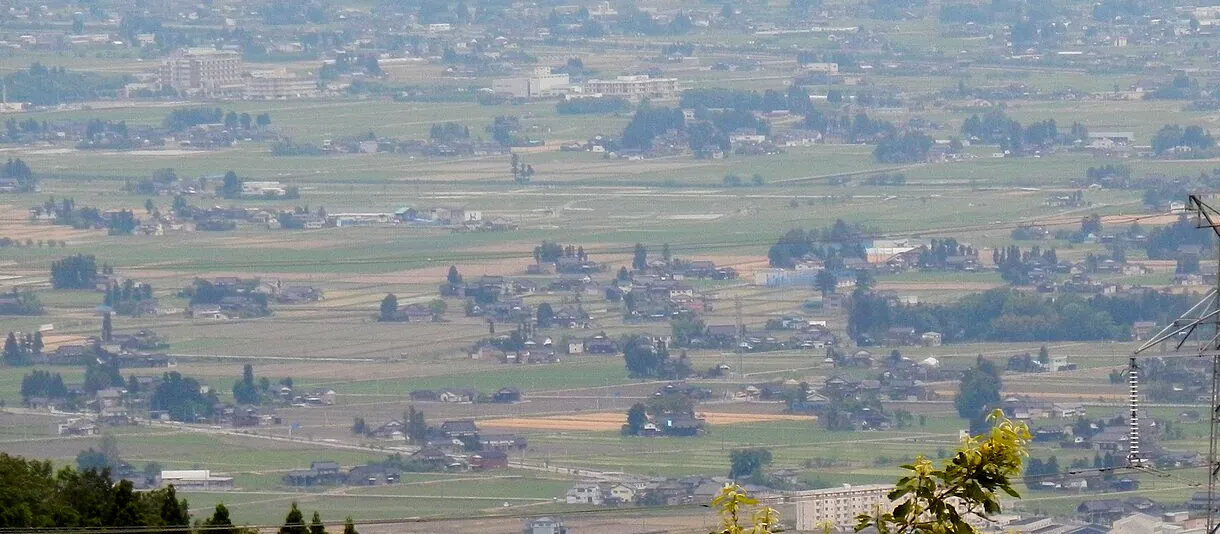
Scattered farmsteads on the Tonami plain (Shogawa, Tonami)The scattered farmsteads of the Tonami plain seen from a hilltop, houses ringed by windbreak groves dotted among the rice fields
Photo: kiwa dokokano "Shogawamachi Kakuryou, Tonami"(CC BY-SA 3.0), cropped
1 Find out the no-demolition price of a house you were told is worth ¥0Free appraisal on LINE 2 9:00–17:00, Japanese only / after 17:00: Call us
1970Founded / Yatsuo, Toyama City
Real estate + constructionA builder with both a real estate licence and a construction permit
Appraisal and survey: ¥0No charge if you decline
Toyama, Ishikawa and HidaOwners living elsewhere welcome

What the houses called unsellable have in common

"Unsellable" is not decided by the condition of the house alone. It is decided by which is larger: the land value, or the cost of demolishing and clearing.

When an agent says the house cannot be sold or is worth ¥0, they are not saying it has no value. Most of an agent's buyers are people who will demolish the old house and build their own. So the agent's appraisal starts by treating the building as if it were not there and pricing the land. From that it deducts the demolition cost, then the cost of clearing the contents. What remains is the price of the house. If the land is worth less than demolition plus clearing, the answer is ¥0 or negative.

A house that is called unsellable has several conditions stacked up that break this formula. One is low land value: in Toyama's old villages, seaside fishing towns and the hills of Noto, it is not unusual for even residential land to have a very low price per tsubo. The second is high demolition cost: a 60-tsubo (about 198 m²) farmhouse with a kura, barn and windbreak grove costs twice as much to demolish and clear as a house on its own, and more again where the road is too narrow for machinery. The third is road frontage and farmland: land without 2 m of road frontage cannot be rebuilt on even once cleared, so no buyer wants the empty lot; and attached rice fields need the agricultural committee's permission. The fourth is damage: leaks and tilting reduce the number of people buying to live there, and the agent's buyers narrow down to people who will demolish.

A "negative price" comes from the same formula. If the land is worth, say, ¥1 million and demolition costs ¥1.5 million, the balance is −¥500,000; it only balances once the seller puts in ¥500,000. This is the basis of the offer to "take it over for a fee", and the offer itself cannot be called improper. But it is the answer when demolition is assumed, not the only answer to what the house is worth.

How to tell whether the damage itself is repairable is covered separately in How to tell a damaged house that can be repaired from one that cannot. This article is about how the price is arrived at.

If you first want to sort out whether to demolish or keep at all, use Demolish or keep? A quick check (eight questions, free).

The demolition-based formula: land value − demolition cost − clearing cost

Urban lot (high land value) Land value Demolition (40 tsubo: from about ¥1.5–2 million) Clearing cost Remainder positive → seller receives Old village or seaside hamlet (low land value) Land value Demolition (40 tsubo: from about ¥1.5–2 million) Clearing cost Excess over land value is negative → seller pays e.g. land ¥1 million − demolition ¥1.5 million = −¥500,000 Demolition costs vary little nationwide; land prices vary hugely by area. For the same house, the land value decides the answer
A demolition-based appraisal is "land value − demolition cost − clearing cost". Demolition costs vary little by area, so in an old village or on the coast where land is cheap, the same house comes out at ¥0 or below.

A demolition-based appraisal is made of three numbers: the land value, the demolition cost and the clearing cost. We take them in turn.

1. The land valueThe price as an empty lot is derived from nearby transactions and official land prices. As a rule the building is not included. The older the house, the more the agent's custom is to treat its value as zero.
2. Deduct the demolition costDemolishing a wooden house in Toyama costs around ¥30,000–50,000 per tsubo as a guide, from about ¥1.5–2 million for 40 tsubo (about 132 m²) of floor area. A farmhouse with a kura, barn and windbreak grove commonly exceeds ¥3 million in total. The breakdown is in demolition cost guide.
3. Deduct the clearing costIf the contents are still inside, disposing of them falls to the buyer, so that cost is deducted too. It depends on the amount of contents and whether there is a family altar or farm machinery.

The reason this formula so often gives ¥0 or a negative figure in Toyama is clear. Demolition costs vary little across the country, but land prices vary hugely by area. If demolishing the same 40-tsubo (about 132 m²) house costs ¥1.5–2 million, the land value comfortably exceeds it on an urban lot, but in an old village, a scattered-farmstead area or a seaside hamlet it is quite normal for the land to be worth less. And a Toyama farmhouse, large, with a kura and windbreak grove, and a heavy roof built for snow, is exactly the kind of building whose demolition cost swells.

In addition, clearing the lot removes the residential-land relief on property tax from the following year. Land with a house on it has its taxable base reduced to as little as one-sixth, so demolition raises the tax on the land. Accept a demolition-based appraisal and demolish first, and you keep paying the higher tax until the land sells. Demolishing with no buyer in sight is the most costly order of all.

Our free appraisal gives the price for selling as it stands, and for comparison we can also give a rough figure for the demolition case. Demolish then sell, sell as is, demolish and keep the land: you can compare the three on one table.

What a no-demolition appraisal looks at: posts, beams, foundations and roof structure

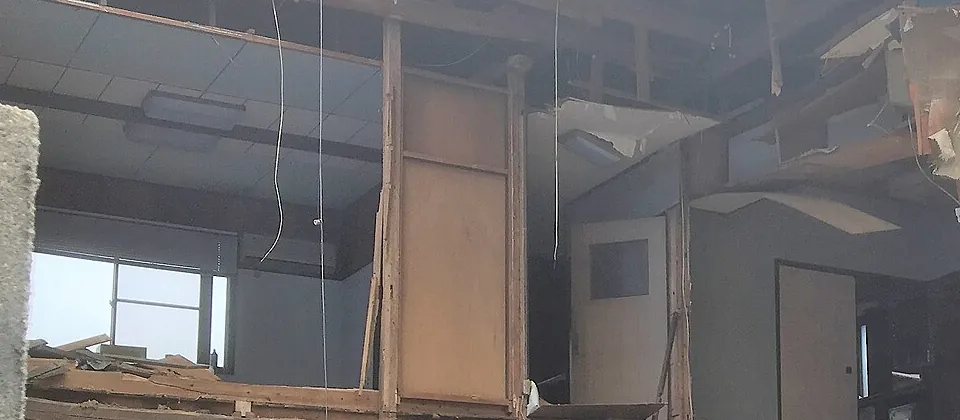
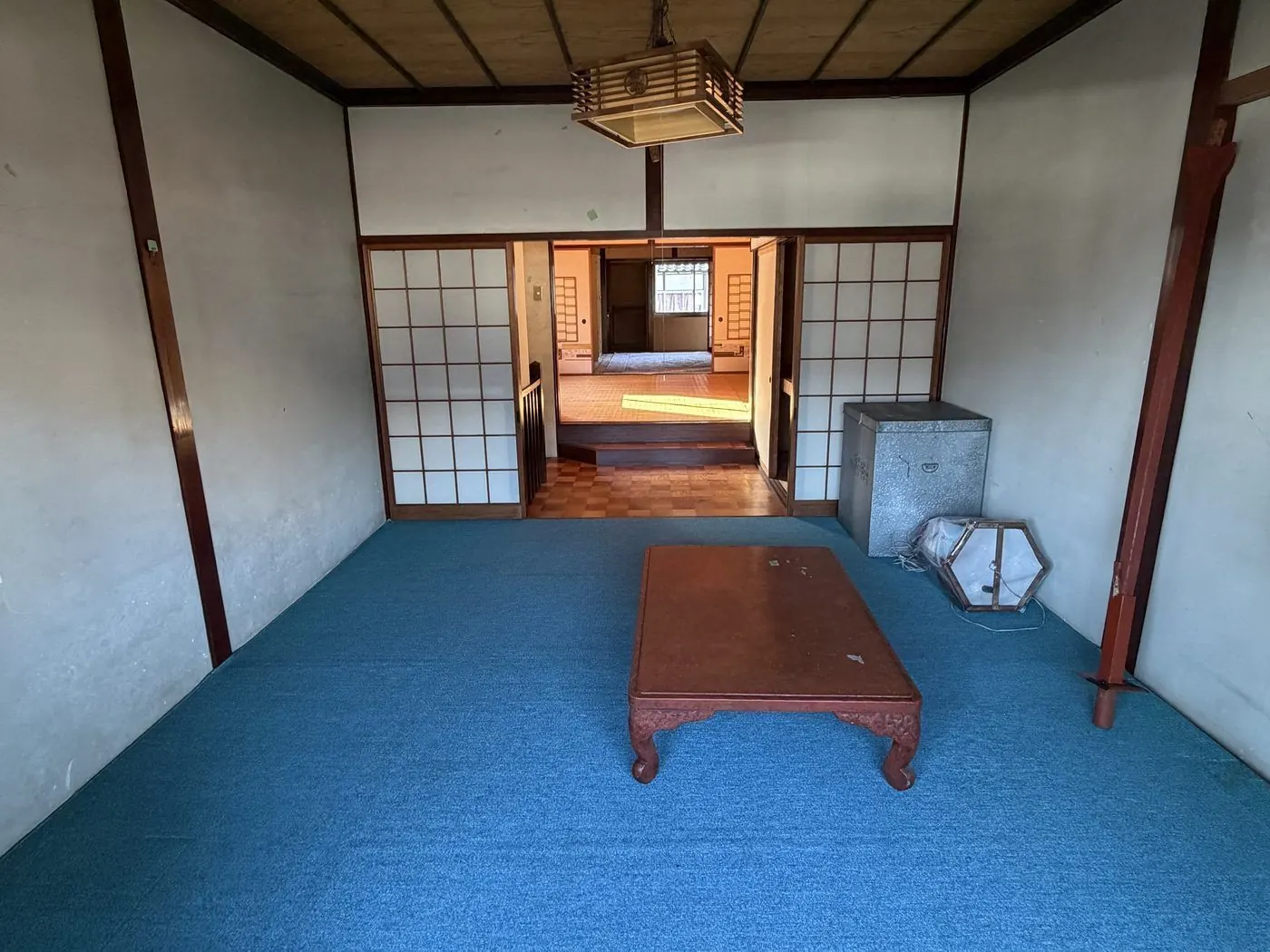
Tatami room before renovation (our project)Kominka turned into a guesthouse: the tatami room before renovation
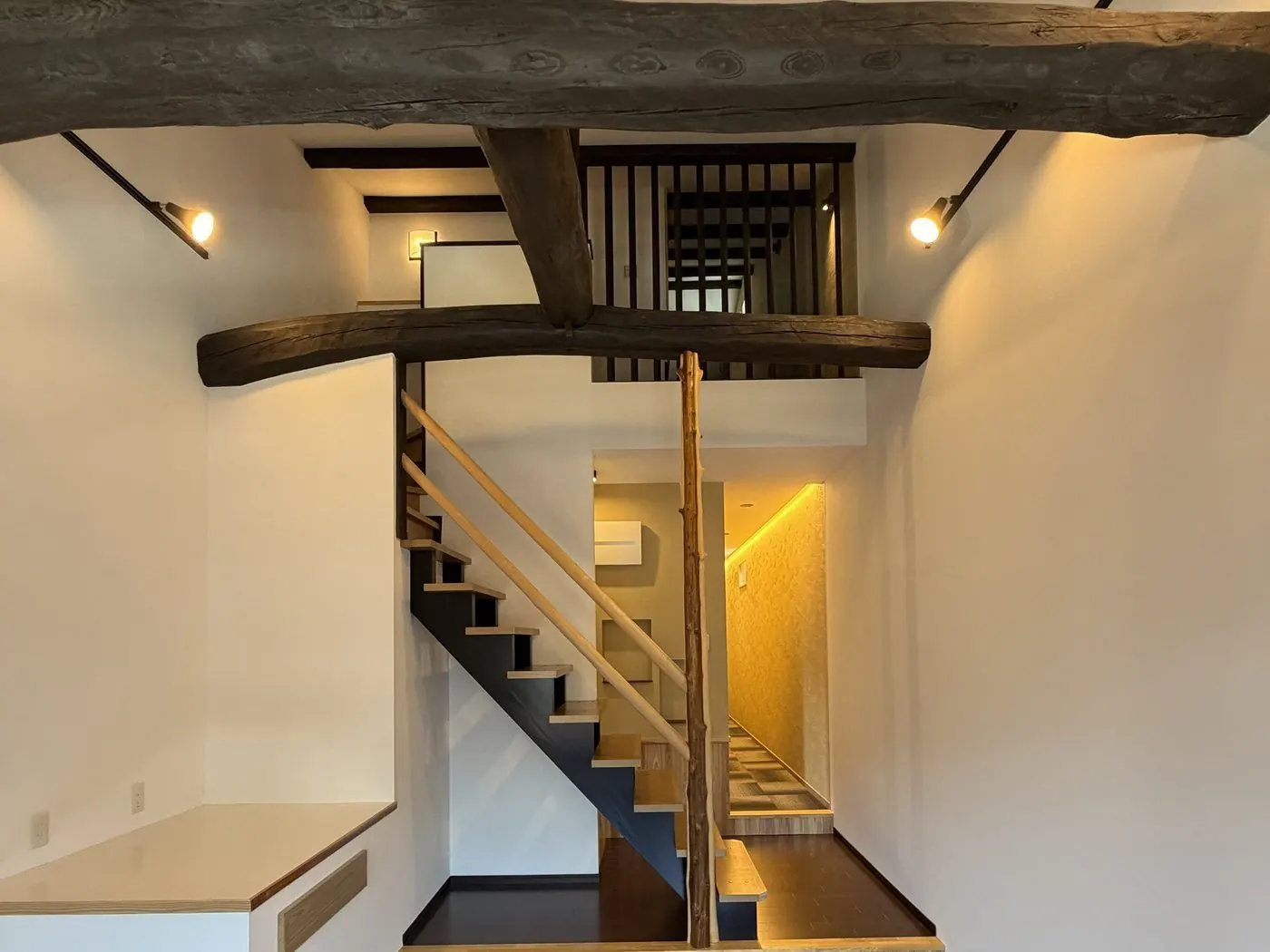
Into a stairwell with exposed beamsKominka opened as a minpaku guesthouse: the stairwell with exposed beams (after)

A kominka we restored. When we opened up the ceiling, this beam appeared. A member that a demolition-based appraisal treats as if it did not exist becomes the centre of the valuation on a no-demolition basis. Four months' work, building cost ¥9 million. → See this case in detail

Our appraisal uses a different formula. Our policy is not to demolish what we buy but to repair it and pass it to the next occupant, so for a house with a usable frame we do not deduct demolition cost from the price. We never intended to demolish it. What we look at instead is the building's frame.

  • Posts and beams. Their size, the species of timber, any rot or insect damage. Hokuriku farmhouses were built with heavy timbers to bear the snow, and many over 80 years old still have a sound frame
  • Foundations and sill plates. Whether the posts stand on stones or a strip foundation, rot in the sill plates, settling of the footing stones. Even a tilt is repairable if the cause is the sills or the stones. See Can a leaning house be repaired?
  • The roof structure. Even with traces of leaks, if the roof framing timbers are alive, re-roofing stops it. Replacing heavy tiles with lighter roofing helps with both snow and earthquakes
  • What the layout and location can be used for. Repaired as a home, or converted into a guesthouse or shop? The streetscape of a fishing town or old quarter is, if anything, a draw for a shop or guesthouse

Even with leaks, a lean or termites, there is one condition, when you get down to it, that decides whether a house still has value: is the structural timber sound. Damage to the finishes and damage to the structure are two different things. Walls, tatami and plumbing can be repaired. But if the main posts or beams have rotted away, the repair cost exceeds the house's value. So our appraisal does not put a price on everything unconditionally either. We look at the frame on site, weigh the repair cost against what the house can go on to be used for once repaired, and set the purchase price from the difference.

Value as real estate and value as a building are two different things. A house an agent could not price is quite often worth something when we buy it directly.

Five ways to let go: the ones where you are paid, and the ones where you pay

Paid to let go ¥0 Pay to let go 1 Agent Receive Sold as land with old house Ceiling near market value 3 months to years to sell Fee 3% + ¥60,000 + tax Defect liability remains 5 As-is sale to us Receive We buy, contents included Lower than via an agent Handover in as little as 2 weeks No brokerage fee No defect liability 2 Vacant-house bank ¥0 Listed at the municipal desk Listing is free Sale depends on a taker Many listings at ¥0 Upkeep continues 3 Free transfer ¥0 Given to a person for ¥0 Recipient pays tax Contract and registration DIY You carry any disputes Defect liability remains 4 State takeover, donation Pay Not with a building on it Demolish first at own cost Fee ¥14,000 per parcel Contribution ¥200,000 as a rule Donations rarely accepted Paying to let go (3, 4) comes after being paid to let go (1, 5) is closed
The scale is whether you receive money or pay it. Check that the paths where you receive (agent, as-is sale) are closed before moving on to the ¥0 and paying paths.

Even a house you were told is unsellable has five ways out. The scale to set them on is whether you receive money or pay it. Then whether demolition and clearing are needed, how long it takes, and what liability remains after handover.

1. Sell through an agent as "land with an old house"The ceiling is the land value minus demolition and clearing costs. If a buyer is found you receive close to market value, but it takes three months to several years to sell, and the seller bears the brokerage fee (3% of the price + ¥60,000 + tax) and liability for defects after handover. A house called ¥0 is one that found no buyer on this path.
2. List it on the vacant-house bankYou register at the municipal desk and wait for would-be movers to come looking. It costs nothing, but when it sells depends on the other party, and many listings are priced at ¥0. The more damaged the house, the fewer the enquiries, and the upkeep continues after listing. How to use it is in How to use the vacant-house bank.
3. Give it to a private individual for freeGiving it to a neighbour or acquaintance for ¥0. No money changes hands, but the recipient pays tax, you arrange the contract and registration yourself, and you carry any disputes after handover. Detailed in the next section.
4. State takeover, or donation to the municipalityThe scheme for handing inherited land to the state will not take land with a building on it. You demolish first at your own expense, then pay the examination fee (¥14,000 per parcel) and the contribution (¥200,000 as a rule) (Ministry of Justice: inherited land state takeover scheme). Municipalities often decline donations, and may require demolition or a survey as a condition. This is a path where you pay to let go. Details in Renouncing and state takeover.
5. Sale to us as it standsA direct purchase with us as the buyer. Contents left inside, no demolition, no brokerage fee. Handover can be as little as two weeks after the site survey, with no liability for defects after handover. The price is lower than a sale through an agent, but this is a path where you receive rather than pay.

The thinking on order is simple. The paths where you pay to let go (3 and 4) come after the paths where you are paid to let go (1 and 5) are closed. Even if an agent said ¥0, you have probably not yet had a no-demolition appraisal. Skip that and go on to demolition or transfer, and you end up paying to let go of money you could have received.

What happens when you give a house to a private individual for ¥0

"I just want someone to take it, even for nothing." Many people think this and consider giving the house to a neighbour or acquaintance for ¥0. It looks simple because no money changes hands, but three things happen: tax on the recipient, disputes over contents and repairs, and liability for defects between private individuals.

Tax falls on the person who receives it. Say an individual is given property for a very low price. In that case, the gap between the true value (fair market value) and what was actually paid is treated as something received for free, a gift (Inheritance Tax Act art. 7, National Tax Agency Tax Answer No. 4423). The “fair market value” of land or a building is the amount an ordinary sale would fetch — an agent's appraisal of ¥0 does not mean the tax-purposes value is ¥0. There is also “real estate acquisition tax,” charged on whoever acquires land or a house, regardless of whether they paid for it or received it free. It does not apply on inheritance. It does apply on a gift (the rate for housing and land is 3%, until 31 March 2027; Toyama Prefecture: real estate acquisition tax). Registration and licence tax on a change of ownership is also higher for a gift, 2%, against 0.4% of the property's value for an inheritance (National Tax Agency No. 7191, registration and licence tax rate table). A tax bill lands on whoever “receives it for free.” Hand something over without explaining this, and it sours the relationship later.

Contents and repairs cause disputes when agreed by word of mouth. You were told the contents could stay, then after handover you are asked to clear them after all. You are accused of knowing about the roof leak and not saying. Between private individuals there is no intermediary to stop such arguments. Before transferring, put in writing which contents stay, the defects you know of, the boundaries and any arrangements with the neighbours, and have both sides sign.

Liability for defects remains even in a private transfer. ¥0 does not mean no liability. Unless the contract contains a waiver, the recipient may claim repairs or damages for defects found after handover. Whether to include a waiver, and how to word it, is a question for a judicial scrivener or lawyer. Drafting the contract, applying for registration, explaining the tax to the recipient: arranging all of it yourself is what this path really looks like.

When we buy, we prepare the contract, a judicial scrivener we work with handles the registration, and there is no liability for defects after handover. Even if you have someone in mind to give it to, we suggest checking the no-demolition price first. If a house you were going to give away for ¥0 turns out to have a price, the conversation becomes easier for giver and receiver alike.

What to check when offered a paid take-over

Demolition of a wooden houseA wooden house mid-demolition, walls and ceilings stripped to expose the frame of posts and beams
Photo: melvil "Demolition work in japan"(CC BY-SA 4.0), cropped

In recent years, services offering to take over any house for a take-over fee have multiplied. For a house an agent priced at ¥0 or below, they are one way out. We cannot pronounce them good or bad, but the points to check before signing are the same for all of them.

  • Can you see it through to completion of the title transfer? The substance of "taken over" is that the registered title moves to them. If you have paid the fee but the title is still in your name, the property tax and the duty of upkeep are still yours. Put a promise to hand over the certificate of registered matters after completion into the written contract
  • What does the fee consist of? Demolition cost, clearing cost, registration costs, or the operator's own margin? A quote that cannot be broken down cannot be compared. Put it into the formula "land value − demolition cost − clearing cost" and see which items are stacking up
  • Do they hold a real estate brokerage licence? Buying, selling or brokering property as a business requires a licence, and the licence number should appear in the operator's material and contract. Whether it is proper for an unlicensed operator to be the counterparty in a property transaction is a question for the prefecture's real estate licensing department
  • What happens to the house after they take it? Demolished, resold, or left to stand? Your relationships with the neighbours and your relatives continue after the house has changed hands
  • Do you have a figure to compare it with? Whether the fee is reasonable only becomes clear when set against what you could receive. Get a no-demolition appraisal first and you can judge whether paying to let go is really the only path

We hold both a real estate transaction licence (富山県知事(9)第1812号) and a general construction permit, and we repair the houses we buy ourselves. You are welcome to take our appraisal as a competing quote against a paid take-over. There is no charge if you decline.

The difference between an agent's "land with old house" and our as-is purchase

Here, honestly, is the difference between selling through an agent as "land with an old house" and our as-is purchase. We do not claim a sale to us is always better: the amount you receive is higher if the house sells through an agent.

PriceAn agent can aim for close to market value. Our purchase price is lower, because we take on the repair costs, the risk of not reselling and the work of clearing out. In return, we do not deduct demolition cost. For a house called ¥0 or negative, this "not deducting" is what changes the answer.
Fees and costsAn agent charges a brokerage fee of 3% of the price + ¥60,000 + tax, and disposing of the contents is basically the seller's cost. We charge no brokerage fee and take the house contents and all.
TimeThrough an agent, three months to several years; property tax and upkeep continue until a buyer is found. With us, handover in as little as two weeks from the site survey.
Liability after handoverThrough an agent, the seller is liable for defects found after handover. Our purchase waives this within what you have disclosed; we make no claims afterwards.
What becomes of the houseIf the agent's buyer wants an empty lot, the house is demolished. We repair it and pass it to the next occupant.

If you can take your time, clear the contents yourself, and the location will find a buyer, you net more through an agent. Already told ¥0 by an agent, living outside the prefecture and unable to go back and clear out, wanting to stop the upkeep costs, not wanting the house demolished: the more of these apply, the stronger the case for a sale to us. The comparison table is on We buy kominka and vacant houses.

Houses we still cannot take, and the order for getting an appraisal

In this order, you lose nothing Get an appraisal Contents inside, before registration Set the as-is price beside the demolition estimate Compare the three options on one table Demolish, clear out, subsidy Decide after that If you go ahead first (no way back) Demolish first The frame's value is gone Land relief lost, tax rises Clear out first Clearing cost comes out of your pocket May bar renouncing the inheritance Apply for a subsidy first Commits you to clearing the lot Fixes how you can sell
Getting an appraisal alone costs you nothing. Demolishing, clearing out and applying for a subsidy are all steps with no way back once done first.

Even on a no-demolition basis, there are houses we cannot take. We set them out first.

  • Farmland alone, or forest alone. We will discuss them together with the main house, but farmland needs the agricultural committee's permission and we cannot always take it. For the way out, see Selling a family home with rice fields or forest
  • The owner cannot be settled. Some heirs cannot be reached, the co-owners cannot agree, the estate division is not finished. These are not problems we can solve; a judicial scrivener's procedures come first. We can appraise before registration, but inheritance registration must be done before handover (compulsory since April 2024)
  • The main structural timbers have rotted through. Where most of the posts and beams are unusable, the cost of repair exceeds the value of the house. In that case we guide you along the demolition path, and we can give you a demolition quote too
  • Outside our area. We cover Toyama, Ishikawa and northern Gifu (Hida)

Beyond that, there is an order for getting an appraisal. Three "befores".

1. Before demolishingOnce demolished, the value of the frame is gone and the residential-land relief on property tax is lost from the following year. Getting a demolition quote is fine in itself, but set the as-is price beside it before work starts.
2. Before clearing outWe appraise with the contents inside and buy the house that way. Clear out first and that cost comes out of your own pocket. If you are considering renouncing the inheritance, touching the contents can bar you from renouncing, so all the more reason to see a judicial scrivener first.
3. Before applying for a subsidyMost demolition subsidies require applying before work starts and finishing within the fiscal year, and assume the lot will be cleared. Once you apply, how you can sell is fixed. Schemes change each fiscal year, so check the conditions with the municipal desk and the official guidance.

Each of these is a step with no way back once done first. Put the other way, getting an appraisal alone costs you nothing. Send photos and the location and we reply with a rough view before visiting.

When letting go now, even at a loss, makes sense

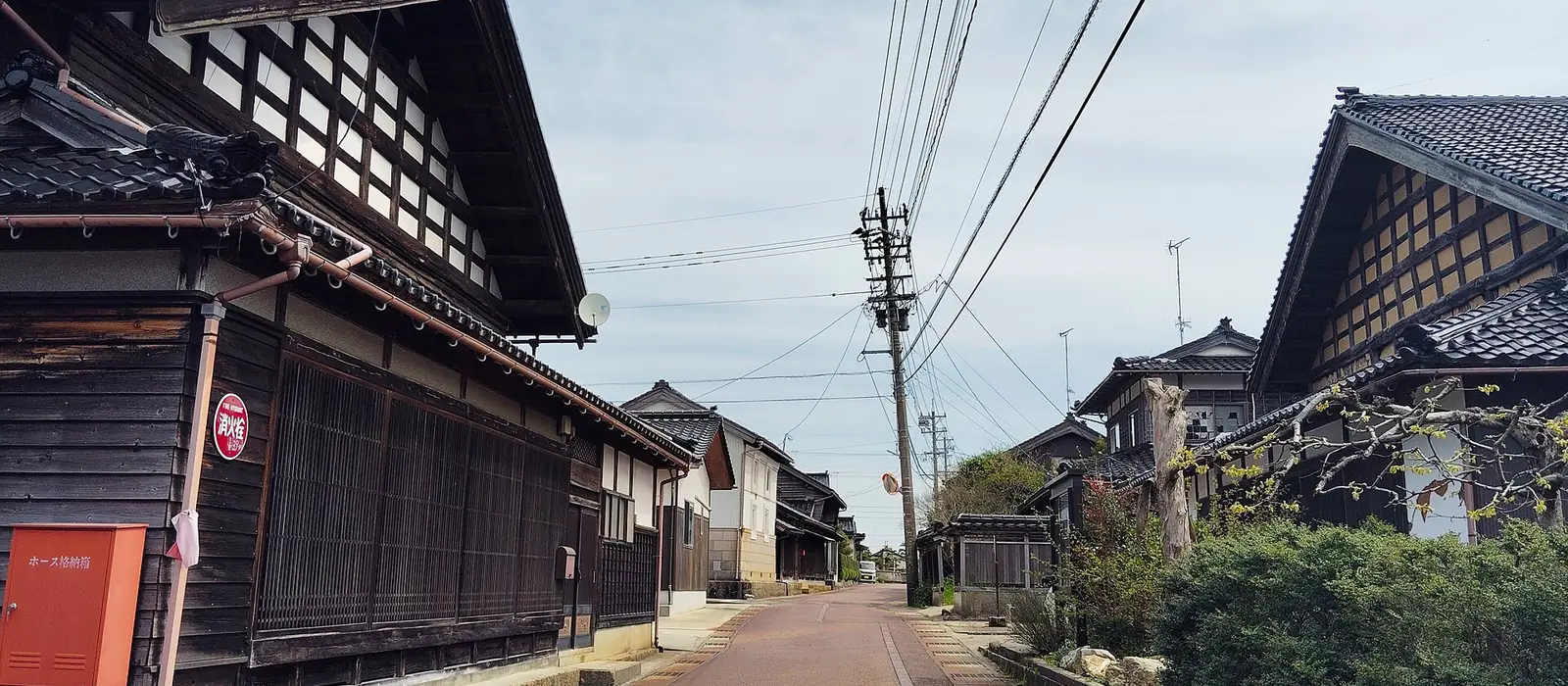
A street in Nakanoto (Ishikawa)Azumadachi (gable-entry) farmhouses lining a narrow lane in Notobe-kami, Nakanoto, Ishikawa
Photo: Asturio Cantabrio "Notobe-Kami 2026-04 ac"(CC BY-SA 4.0), cropped

Some houses have no price even on a no-demolition basis. Then paying to let go becomes rational when the cost of keeping it exceeds what you would pay.

A house nobody lives in costs roughly ¥150,000–400,000 a year for a typical detached house in Toyama: ¥50,000–150,000 in property and city planning tax, ¥40,000–80,000 in fire insurance and standing charges for water and electricity, and ¥60,000–180,000 for grass cutting, garden tree care and snow clearing. The breakdown is in What to do with the family home. Keep it five years and ¥750,000–2 million goes out. Even if you paid ¥500,000 to let it go, that is less than three years' upkeep. On top of that, if the house stays unmanaged the municipality may issue guidance or a recommendation, and the residential-land relief can be lost and the property tax rise. The deterioration continues too, and both the cost of repair and the price it would fetch get worse every year.

So the formula for the decision is this: compare what you would pay to let go against the total upkeep you would otherwise keep paying. But before that, check whether the path of being paid to let go is really closed. That is the whole order.

We have in fact bought, as they stood, houses that other companies turned down.

Toyama Prefecture / 85 years old, two-storey wooden house, lot about 120 tsubo (about 396 m²)The owner had inherited their parents' home and lived in the Tokyo area. Grass cutting and snow had become too much, and other companies had said it could not be sold without demolishing and clearing the lot. We looked at the beams and posts on site, told them it could be repaired and used, and took it contents and all. Letting go without demolishing, they said, freed them from the worry of property tax and upkeep (Mr/Ms T, in their 50s, Tokyo).
A seaside house in HimiFishing towns have narrow streets and high demolition costs, the classic case where a demolition-based appraisal struggles to find a price. We look at the degree of salt damage and the soundness of the frame separately. Damage to the exterior and damage to the structure are different things, and we have rebuilt the outer skin of seaside properties before.
A partially damaged house in Noto, IshikawaWe also appraise, as they stand, houses left partially damaged by the earthquake. As a building contractor we judge whether they can be repaired and kept.

What every example has in common is that a no-demolition appraisal was taken before demolishing. Details of the cases and the situation in each municipality are on the Toyama City, Himi and Ishikawa pages.
FAQ

Can a house over 60 years old really have a price?+−

We do not decide by age. What we look at is the condition of the frame: posts, beams, foundations and roof structure. Hokuriku farmhouses were built with heavy timbers to bear the snow, and many over 80 years old still have a sound frame. Damage to finishes and damage to structure are different things; if the structural timbers are alive, value remains. Conversely, if the main structural timbers have rotted through, a price is hard to put on it, and in that case we say so honestly.

The agent said there is a buyer for the land alone, but the building must be demolished.+−

That is the answer from an appraisal that assumes demolition. It is not wrong, but it is not the only answer. Pay for the demolition yourself and clear the lot, and from the following year the residential land exception for property tax no longer applies, so your tax rises until it sells. Before any work starts, put that figure beside the price for selling the house as it is. Our free appraisal can also give you a rough figure for the demolished case, for comparison.

I already got a demolition quote. Is it too late?+−

If you have only got a quote, you have lost nothing. As long as work has not started, you can still have a no-demolition appraisal. In fact a demolition quote makes it easier to compare the three options on one table: sell as is, demolish then sell, demolish and keep the land. Send us a photo of the quote and we will explain with that in hand.

Can I still talk to you after signing a contract to pay a take-over fee?+−

If the transfer of title has not yet been registered, the house is still in your name and we can appraise it. Whether the contract can be cancelled, and whether a penalty applies, depends on its terms, and that is not something we can judge. The right order is to take the contract to a judicial scrivener or lawyer and get our appraisal in parallel. If the title has already been transferred, there is nothing we can do.

The neighbour says they will take it for free. Should I give it to them?+−

Transferring to the neighbour is not a bad path, in that the person looking after it is close by. But a ¥0 transfer leaves the recipient liable for gift tax (where the gap to market value counts as a deemed gift), real estate acquisition tax and registration tax. Put in writing which contents stay, the defects you know of and a liability waiver, and have a judicial scrivener do the registration. If you get our appraisal before transferring, then if the house has a price you can choose to have the neighbour buy it, or to sell it to us.

If you do not deduct demolition cost, is your figure higher than an agent's?+−

No. Our purchase price is lower than what a sale through an agent would bring, because we take on the repair costs, the risk of not reselling and the work of clearing out. "Not deducting demolition cost" means that a house an agent priced at ¥0 or below can sometimes have a price on a no-demolition basis. If an agent can find a buyer for your house, you will net more through the agent.

I live outside the prefecture and cannot go to see the house. The contents are still there.+−

That is fine. Send photos of the house and its location on LINE and we reply with a view before visiting. We do the site survey ourselves, holding the key. We appraise with the contents in place and buy it that way. The contract can be exchanged by post, and we can appraise even if the inheritance registration is not done.

→ All 49 questions on selling and renovation

This page explains the general approach. Appraisal figures are decided by an on-site survey of each property, and tax treatment depends on individual circumstances. Check tax matters with a tax accountant or your tax office, and registration and contracts with a judicial scrivener. The schemes and figures are as of September 2026 and change each fiscal year. The official guidance of the National Tax Agency, the Ministry of Justice and Toyama Prefecture takes precedence.

Know the no-demolition price.

Photos of the house and its location are all we need. Contents inside, before registration, from outside the prefecture — all fine. If you have another company's appraisal, send it along. The appraisal is free, and there is no charge if you decline.

Send photos on LINE Ask us by form
By phone (Japanese only) 9:00 - 17:00 After 17:00, site manager (Japanese only)

Also read alongside this.

The breakdown of demolition costs, how to tell a repairable house from one that is not, renouncing and state takeover, the upkeep of a family home. The material you need for the decision.

Demolition costs, and what to know first → A damaged house: repairable or not → Renouncing and state takeover → What to do with the family home: upkeep and three paths →

Written by Kota Makimura, Hokuriku Homes Updated

Phone9:00–17:00 LINEAppraisal from photos Free appraisalTakes 1 minute
LINEChat