We buy kominka and vacant houses in Ishikawa / Noto, Nanao, Komatsu, Kaga

We buy vacant houses and kominka in Ishikawa

A family home in Noto, a townhouse in Nanao, a farmhouse in Komatsu or Kaga. Anywhere in Ishikawa outside Kanazawa, we buy as-is on the same terms. We do not demolish the houses we buy; we repair them and pass them to the next occupant.

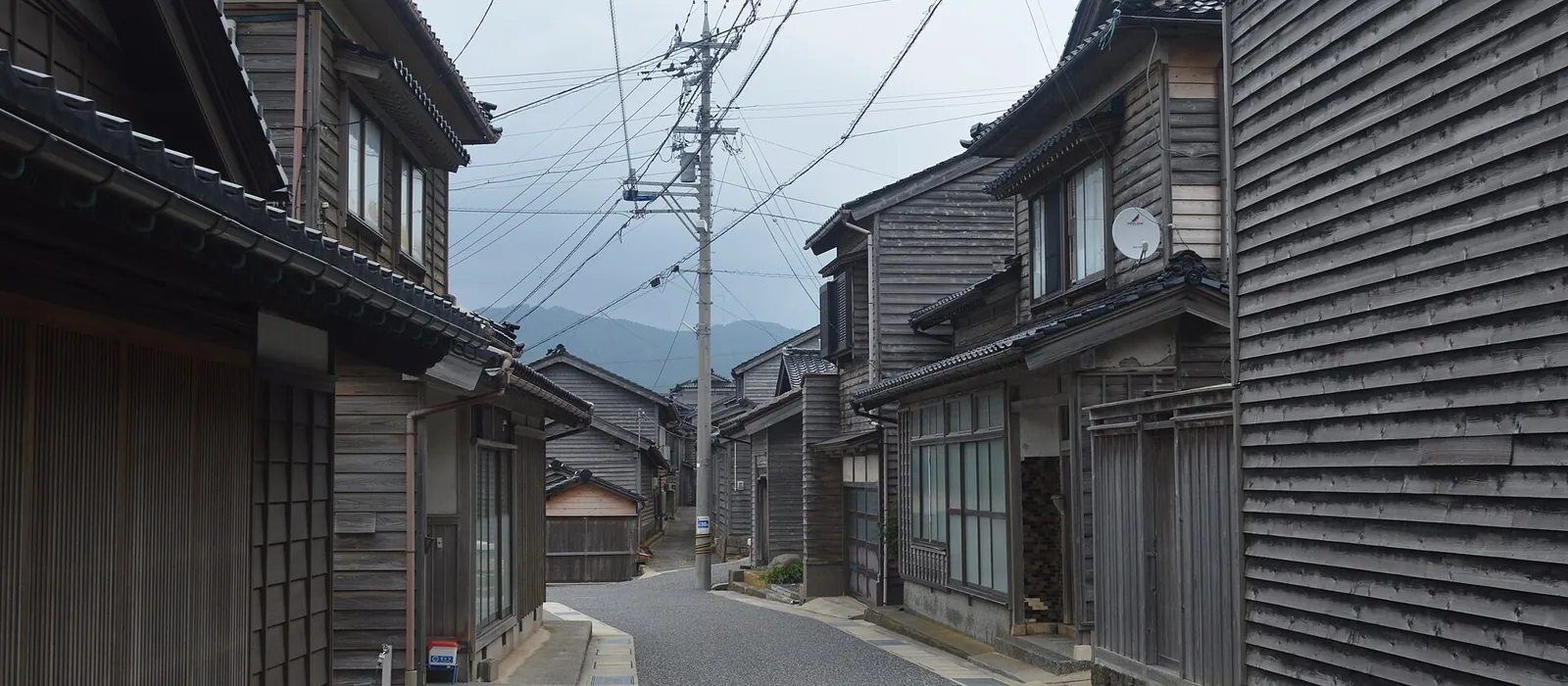
A Noto streetscape (Kuroshima district, Wajima City)The Kuroshima district of Wajima City, with clapboard-clad houses under black-tiled roofs lining both sides of the street
※ Street scene in Wajima, not a property we handle. Photo: Asturio Cantabrio "Kuroshima townscape ac (15)"(CC BY-SA 4.0), cropped
1 Photos and the location are enough for a rough estimateFree consultation on LINE 2 9:00–17:00, Japanese only / after 17:00: Call us
1970Founded / Yatsuo, Toyama City
Real estate + constructionA builder with both a real estate licence and a construction permit
Site survey ¥0No charge if you decline
All of Ishikawa PrefectureSame terms from Noto to Kaga

We buy on the same terms across Ishikawa, outside Kanazawa City too

We cover the whole of Ishikawa Prefecture. Kanazawa City has its own page; this page covers the rest, the municipalities of Noto and Kaga together. The terms are the same as for Kanazawa.

Noto area

  • Nanao
  • Wajima
  • Suzu
  • Hakui
  • Noto Town
  • Anamizu
  • Shika
  • Nakanoto
  • Hodatsushimizu

Kaga area

  • Komatsu
  • Kaga
  • Hakusan
  • Nomi
  • Nonoichi
  • Kahoku
  • Tsubata
  • Uchinada
  • Kawakita
  • and the rest of Ishikawa
  • No clearing out. We take the house with the contents and altar still inside
  • No brokerage fee. A direct sale with us as the buyer
  • Handover as little as two weeks after the on-site survey
  • Even with leaks, tilting or termites, even earthquake-damaged
  • Even before inheritance registration, even if co-owned
  • Even non-rebuildable with no road frontage, even with farmland or forest attached
  • Living outside the prefecture? Everything can be done without coming back
  • The appraisal is free, and declining costs nothing. Even if damage or a defect is found after you hand the house over, you as the seller bear no liability for it

We also cover municipalities not listed above. Just tell us the location and roughly what state the house is in.

Ishikawa's houses, and why they fall empty

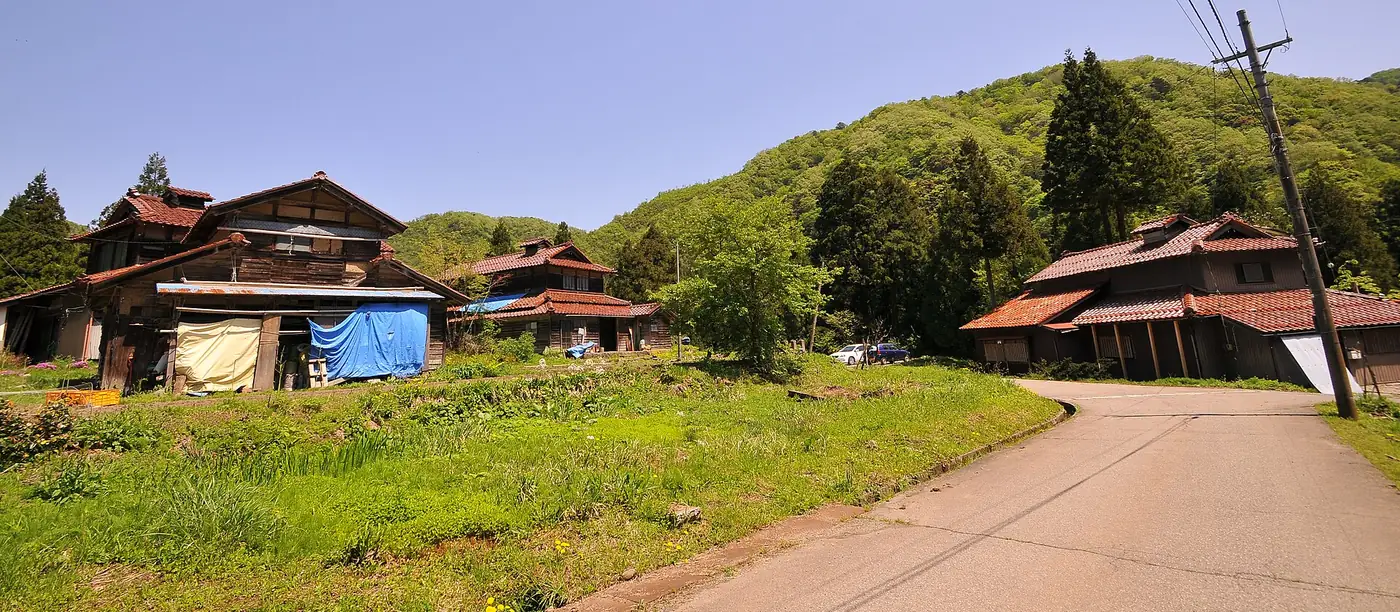
A mountain village in Kaga (Higashitani district, Kaga City)The Higashitani district of Kaga City, with red-tiled farmhouses standing against the mountains
※ Street scene in Kaga, not a property we handle. Photo: Isoyan "Kaga-shi Kaga-higashitani, Ishikawa"(CC BY-SA 3.0), cropped

Ishikawa is long from north to south, and both how houses are built and why they fall empty differ by area. Three types come up most often in the enquiries we receive.

Noto: houses whose owners moved away on inheriting. In the villages of Wajima, Suzu, Noto Town, Anamizu, Shika and Nakanoto, it is common for a house lived in until the parents' generation to fall empty on inheritance. The owner is in Kanazawa, Kanto or Kansai, coming back a few times a year only to mow and air the house. Since the 2024 earthquake, even those visits have become difficult for many.

Nanao: port-town machiya and fishermen's houses. Central Nanao still has narrow-fronted, deep machiya, and along the shore are fishermen's houses with barns. Both sit on long, narrow lots, and conditions such as no car access or eaves touching the neighbour's are common. Demolition is expensive, so an appraisal that assumes clearing the lot gives them little value.

Komatsu and Kaga: farmhouses, merchant houses and hot-spring towns. Villages on the Kaga plain have many large farmhouses with windbreak groves and kura, and it is these houses, spacious but with only a few rooms in use, that end up empty. Along the old highways of Komatsu and Kaga, merchant buildings remain, and in the hot-spring towns of Yamashiro, Yamanaka and Katayamazu there are empty buildings once used as inns and shops.

Whichever type it is, if the frame is sound the house can be repaired and passed to the next resident. We are a builder whose policy is not to demolish the houses we buy. The prefecture's overall vacant house measures are set out in Ishikawa Prefecture, "Promoting vacant house measures".

Earthquake-damaged houses too: consult us as they are

Disaster certificate category Totally destroyed / large-scale half-destroyed Medium-scale half-destroyed / half-destroyed Eligible for publicly funded demolition Applications closed in each municipality Near half-destroyed / partially damaged Not eligible → left standing with the damage We judge on site whether it can be repaired and kept Repair and keep Keep living there or rent out Let it go as-is We buy it with the damage as it is
What became of houses by disaster certificate category. Near half-destroyed and partially damaged houses, not eligible for publicly funded demolition, are still standing with the damage. We judge on site first whether a house can be repaired and kept; whether to keep or let go is the owner's decision.

After the Noto Peninsula earthquake of January 2024, the fate of houses in Ishikawa was decided by the category on the disaster victim certificate. Houses classed totally destroyed, large-scale half-destroyed, medium-scale half-destroyed or half-destroyed qualified for publicly funded demolition. Near half-destroyed and partially damaged did not. Applications for publicly funded demolition have already closed in each municipality. For the current position see Ishikawa Prefecture, "Demolition and removal of disaster-damaged buildings (publicly funded demolition)".

As a result, many partially damaged houses are still standing as they were. Slipped tiles, cracked walls, doors that no longer close properly. Houses given only emergency repairs, where time has passed without a decision on what to do next.

We're not in the business of urging you to let go quickly. As a builder, what we can tell you first is whether the house can be repaired and kept. Houses in Hokuriku are built with thick posts and beams, so even when a house looks damaged, the posts and beams are often fine. We check the posts, beams, foundation and roof framing on site and give you what you need to decide whether it's realistic to keep living in it, rent it out, or let it go. How to assess a house after an earthquake is set out in the seismic reinforcement page, “After the Noto Peninsula earthquake”.

If you then decide to let it go, we take it directly, damage and all. There is no need to repair before selling. Send the category on your disaster victim certificate and photos of the damage, and we reply with a rough estimate.

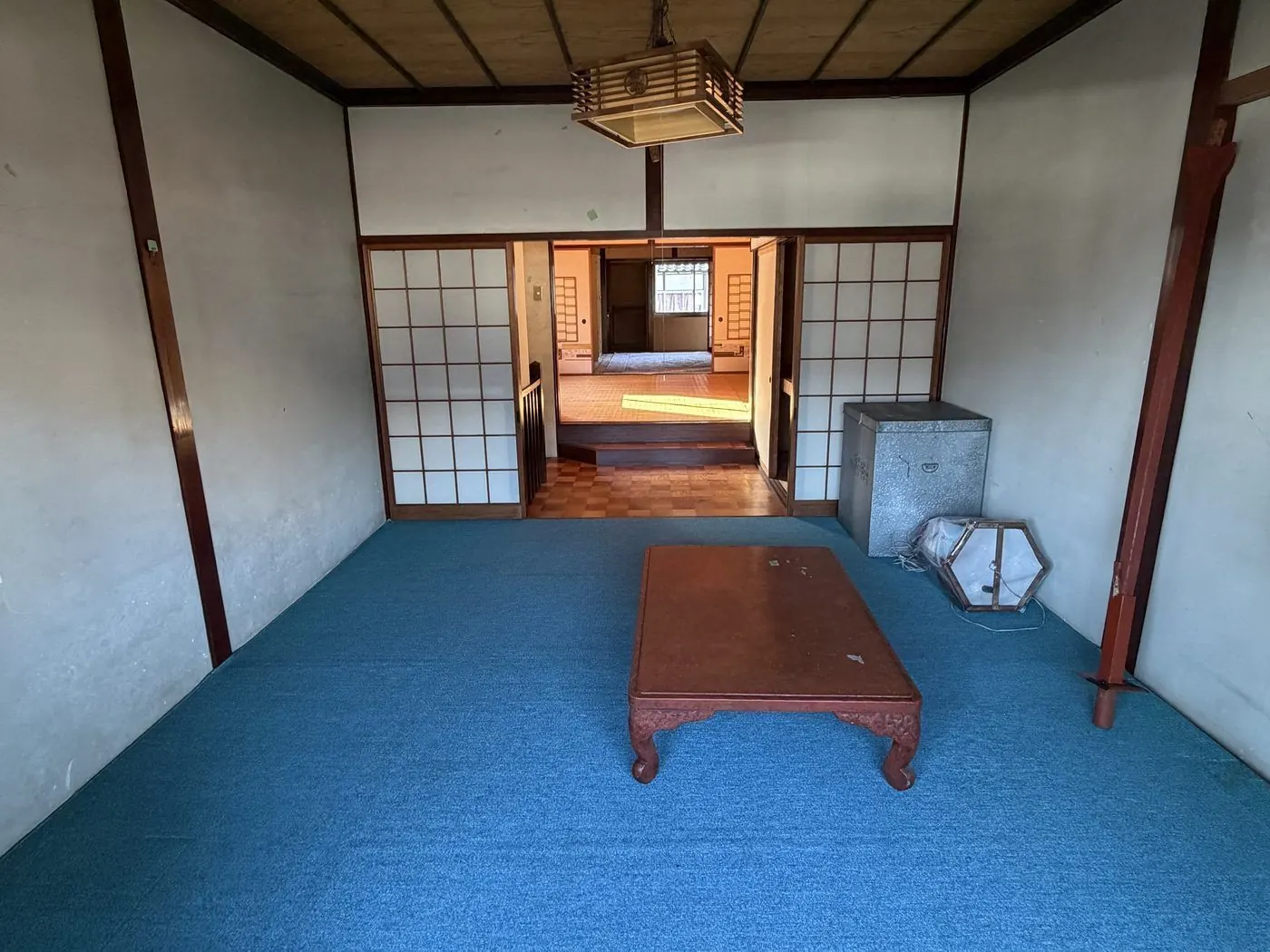
BeforeKominka turned into a guesthouse: the tatami room before renovation
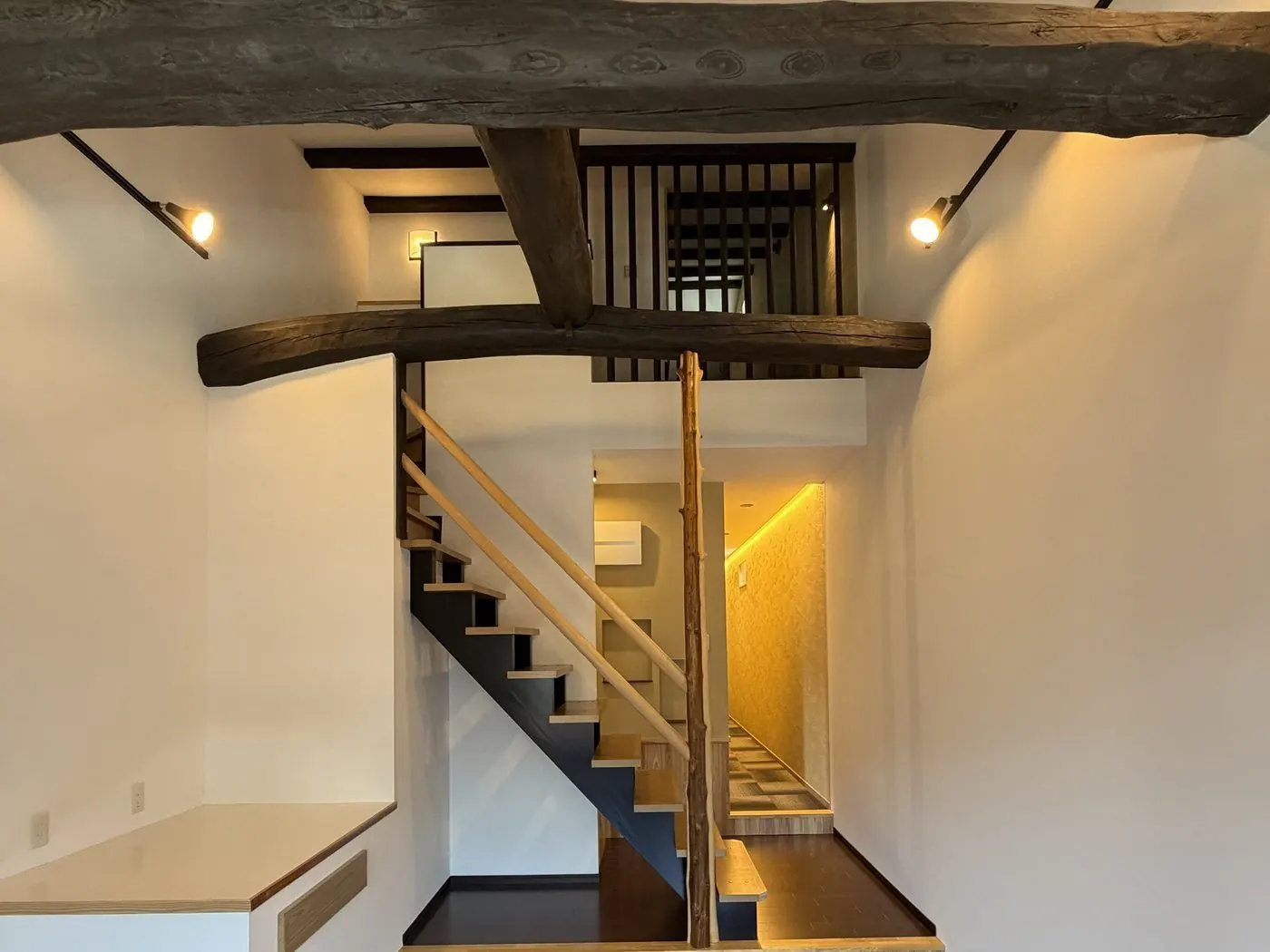
AfterKominka opened as a minpaku guesthouse: the stairwell with exposed beams (after)

This is how the houses we buy and repair reach their next user. Here we removed the tatami room ceiling to expose the beams, and the house opened as a minpaku under a Private Lodging Business Act notification. We are also a registered private-lodging management operator (registration no. 国土交通大臣(01)第F06163号), so the lodging route, right through to management after notification, can be handled by one company. → See this project / → Turning a kominka into a guesthouse

How houses sell in Ishikawa, and when to use the vacant house bank or the advice desk

Vacant house bank (municipal) Agent (licensed broker) Direct sale (to us) Suits Habitable houses, or those needing minor repairs Houses you want to sell high, given time Uncleared houses Damaged or far-away houses Features Listing conditions apply Contents or damage may bar listing Wait for enquiries Price may beat a direct sale Wait until it sells Owner bears the risk of no sale No fee, as-is with contents Handover in as little as 2 weeks Price lower than via an agent You can consult us even while listed with a bank or an agent
Three ways to let go of a vacant house. Which to choose depends on the condition of the house and the time the owner has. Our price is lower than via an agent; in return we take on the clearing, repairs and the risk of no sale.

There are broadly three ways to let go of a vacant house in Ishikawa: the municipal vacant house bank, brokerage by a licensed agent, and a direct sale to a buyer like us. Which is right depends on the condition of the house and the time the owner has.

A vacant house bank suits a house that's ready to live in. Ishikawa Prefecture runs the Ishikawa Prefecture Vacant House Bank site, and municipalities such as Nanao, Komatsu and Kaga run their own banks too. But in most municipalities, only a house that's ready to live in, or needs just minor repairs, can be listed on the bank. A house still full of belongings, or one damaged by the earthquake, may not be accepted. In practice, even when listed, enquiries often don't come.

If you are still undecided, the prefecture has an advice desk. The Ishikawa Vacant House General Advice Desk is run by the Ishikawa Real Estate Transaction Association, for people who have not yet decided whether to sell, rent, manage or demolish. You are welcome to get the overall picture there first and then ask us for an appraisal.

A direct sale to us suits houses that are uncleared, damaged or far away. Our price is lower than a sale through an agent would bring, because we as the buyer carry the repair costs, the risk of not reselling and the work of clearing out. In return, handover can be as little as two weeks, as-is with the contents inside. You can consult us while the house is listed on a vacant house bank or with an agent, and decide whether to continue after seeing our figure.

For houses in Noto, Nanao, Komatsu and Kaga, what we look at is not the value of the land once cleared but the value of the house once repaired and in use. The better built the house and the higher its demolition cost, as with machiya and farmhouses, the bigger the gap between an appraisal that assumes demolition and one that does not.
Snow, roads and land in Ishikawa

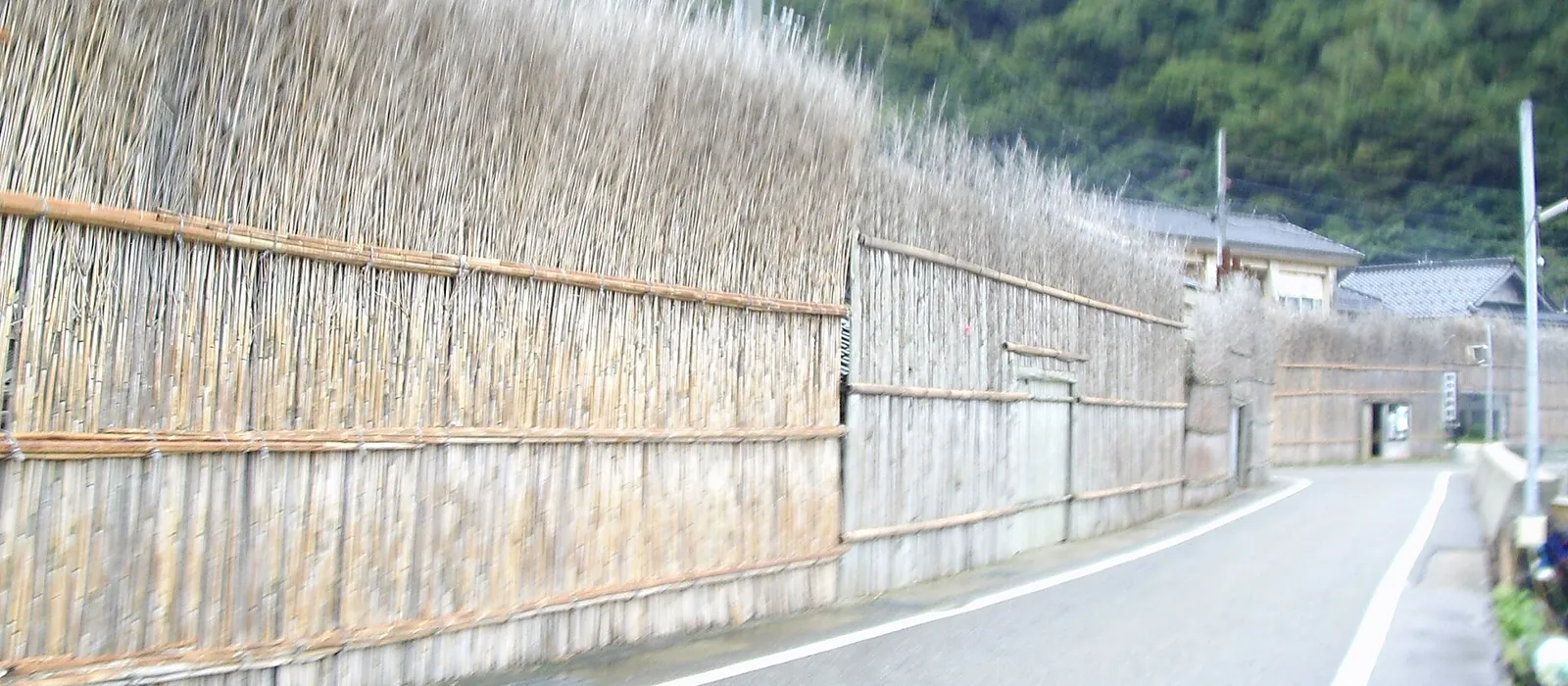
Magaki bamboo windbreaks on Noto's outer coast (Osawa, Wajima City)The village of Osawa, Wajima City, where tall magaki bamboo fences run along the road to block the seasonal wind from the Sea of Japan
※ Street scene in Wajima, not a property we handle. Photo: Indiana jo "Oosawa-Magaki Settlement 2"(CC BY-SA 4.0), cropped

In Noto, it is sea wind rather than snow. Villages on the outer coast take the Sea of Japan wind head-on, and metal roofs, gutters and the nails in the cladding rust with the salt. Board cladding and tiles resist salt well, but once a house is empty and maintenance stops, rainwater finds its way in through rusted gutters and the damage spreads from the eaves and the sill. On our on-site survey, this water path is the first thing we look at.

Kaga gets heavy, wet snow. On the plains of Komatsu, Kaga and Hakusan, heavy snow sits on the roof just as in Kanazawa. The big roof of a farmhouse is framed with thick beams to carry that weight, which is also why these houses "can be repaired and kept". But once a house is empty and the snow is no longer cleared, slipped tiles and broken gutters pile up year after year.

We check the road and any waterway before appraising. In Noto villages and rural Kaga, the road in front of a house is often an unregistered public path (a "red line" on the map), or a waterway (a "blue line") runs between the lot and the road. A house not fronting a road under the Building Standards Act is "non-rebuildable": it cannot be replaced. An appraisal that assumes clearing the lot gives such land little value, but because we repair and use the house, we can sometimes buy it. How this works is in selling a non-rebuildable house with no road frontage.

How it works from outside the prefecture

Steps without coming back 1 Send photos and the location Photos and address on LINE → rough estimate back No plans or register needed 2 Post the key We check the house Report by photo and video No need to be present 3 Registration and ID check Our scrivener registers the inheritance ID check on paper and online 4 Contract and handover Contract exchanged by post We dispose of contents and cut off power and water As little as 2 weeks from the site visit Zero or one visit home. If we need one, we tell you the reason and dates in advance
Four steps without coming back: photos and location, the key, registration, then the contract, all by post, LINE and online. As little as two weeks from on-site survey to handover.

In most enquiries about houses in Ishikawa, the owner lives outside the prefecture. Even from Kanazawa or Toyama, the far end of Noto is not an easy round trip. We have a procedure that runs without you coming back.

1. Send photos and the locationSend photos of the house and the address on LINE. If you have no photos, the address alone is enough for a first rough estimate. No plans or property register needed.
2. Post the keyWe check the house and report on the inside with photos and video. We see the family home you haven't seen in a while before you do. No need to be present.
3. Registration and identity checkInheritance registration must be done by handover (compulsory since April 2024). We introduce our partner judicial scrivener, and the identity check is done on paper and online. The cost of registration is set out in the scrivener's quote.
4. Contract and handoverThe contract is exchanged by post. We dispose of the contents and cut off the power and water. As little as two weeks from the on-site survey.

In most cases you come back zero or one time. If we need one visit, we tell you the reason and dates in advance. The steps in detail, and how to proceed with a house inherited jointly with siblings, are in selling without coming back. For tax and deadlines when selling an inherited house see the guide to selling an inherited home, and for the ¥30 million special deduction for vacant houses see this page.

Available schemes: names and official links only

Ishikawa Prefecture and its municipalities have schemes supporting the sale of disaster-affected residential land and the renovation or demolition of vacant houses. Amounts and deadlines change each fiscal year and application status differs by municipality, so we list only names and official links here. Always check the official page.

Most renovation subsidies require "applying before work starts"; sign a contract or begin work first and you lose eligibility. The schemes available differ depending on whether you sell, repair and rent, or turn the house into lodging, so we check them together with your appraisal. How to find schemes is in finding subsidies, and renting rather than selling is in using a vacant house without selling.

Request an appraisal for a property in Ishikawa.

Just three fields. It takes a minute. If you have photos, LINE is faster.

Request a free appraisal Ask us on LINE
Or call us (Japanese only) 9:00 - 17:00 After 17:00, site manager (Japanese only)

Frequently asked questions about Ishikawa

Will you buy a family home in Noto that comes with rice fields or forest?+−

Ask us. Farmland needs the agricultural committee's permission and follows different procedures from a house lot. Sometimes we can take it, sometimes not; we check the registered land category and give you a clear answer. If you don't know the category, we look it up. Another way is for us to take the house and its lot first, and find a separate route for the farmland.

The house is co-owned with my siblings and we can't agree.+−

You can talk to us at that stage. A sale needs every co-owner's agreement and signature, but most discussions stall not because of bad blood but because there is no figure to decide on. Once you have our appraisal and the reasoning behind it, the conversation becomes concrete. If you like, we join your siblings' LINE group and give everyone the same explanation at the same time.

The family altar and memorial tablets are still there. Should I clear them out before asking?+−

Leave them. We dispose of the contents, so no clearing out. For the Buddhist or Shinto altar we may ask you to arrange the closing rite; if you don't know how, ask us. For memorial tablets and keepsakes, we always ask your wishes before disposing of anything.

The house was classed as "partially damaged" after the Noto Peninsula earthquake. Can it be sold?+−

Yes, as it is. "Partially damaged" houses were not eligible for publicly funded demolition, so many are still standing with the damage. As a builder, we look at the slipped tiles, wall cracks and misaligned doors on site and judge first whether the house can be repaired and kept. Visible symptoms and structural damage are not always the same thing. Send the category on your disaster victim certificate and photos of the damage on LINE and we reply with a rough estimate.

→ Three things to look at in the frame of a collapsed house

The house is listed on the city's vacant house bank but nobody has enquired. Can I consult you at the same time?+−

Yes. You can consult us while it stays listed on the bank, and decide whether to keep it listed after seeing our offer. Many municipalities only accept a house that's livable, or needs just minor repairs, for their vacant house bank, so in practice a house that's still full of belongings or damaged rarely finds a buyer there. Our price is lower than a sale through an agent would fetch — the difference is what we take on: the clearing out, the repairs, and the risk of it not selling.

I live outside the prefecture and can't get back to Noto. Can it still go ahead?+−

Yes. Post us the key, we check the house and report with photos and video. The contract is exchanged by post, and identity checks and inheritance registration are handled by our partner judicial scrivener on paper and online. In most cases you come back zero or one time. If we need one visit, we tell you the reason and dates in advance.

→ All 49 questions on selling and renovation

* Publicly funded demolition, the disaster-affected residential land programme and each municipality's vacant house bank change their requirements and application status by fiscal year and municipality. Amounts and deadlines are not given on this page. Always check each municipality's official page.

Our purchase terms and frequently asked questions.

How we differ from an agent, how co-ownership and farmland are handled, and the steps from far away.

Selling a kominka or vacant house: overview → Kanazawa City → What to do with the family home → Sell without coming back →

Written by Kota Makimura, Hokuriku Homes Updated

Phone9:00–17:00 LINEAppraisal from photos Free appraisalTakes 1 minute
LINEChat